Get Full Government Meeting Transcripts, Videos, & Alerts Forever!
Get email alerts on the Planned Development Enabler topic
No spam. Unsubscribe anytime.
Treasure Island Local Planning Agency recommends drafting "planned development" enabling ordinance
Summary
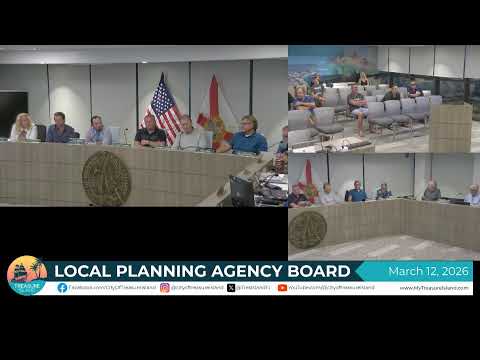
On March 12, 2026 the City of Treasure Island Local Planning Agency voted 5–2 to ask the city commission to have the city attorney draft a "planned development" (PD) enabling ordinance. Supporters said the tool would speed redevelopment and allow negotiated public benefits; opponents urged waiting for master-plan economic studies and warned about commission authority over height and density.
On March 12, 2026 the City of Treasure Island Local Planning Agency (LPA) voted 5–2 to recommend that the city commission instruct the city attorney to draft a planned development (PD) enabling ordinance, a change to the city's Land Development Regulations that would create a PD zoning category and a process for individual, parcel-specific PD applications.
The vote followed extended discussion and public comment. Marvin Shavelin moved the recommendation and Ross Sanchez seconded; the roll-call vote was Yes — Mark Sheski, Ross Sanchez, Daniel Billingsley, Marvin Shavelin and Richard Harris; No — Chris Downing and Grant Smith (Valerie Aree was an alternate and her vote was not counted). The motion directs the city attorney to draft an ordinance that would establish the PD zoning enabler and associated application criteria for later project-specific rezones.
Why it matters: a PD enabler creates a formal, uniform process so property owners can apply to rezone individual parcels as a planned development, typically trading negotiated public benefits (parks, infrastructure, design commitments) for flexibility on setbacks, uses or configuration. Proponents said Treasure Island currently lacks any PD category and that creating the enabling ordinance will allow owners who are ready to apply to begin the rezoning process without waiting for the master plan to be completed.
What the LPA heard: Mr. Brooks, who explained legal and technical options, told the LPA that an enabling PD ordinance is typically boilerplate to establish the PD zoning category and the submission requirements, but that the substantive criteria for evaluating individual PD applications (traffic, water/sewer capacity, stormwater, surrounding uses, required studies and development-agreement provisions under Chapter 163) should be included in the enabler. He advised that PD approvals must still be consistent with the comprehensive plan and that if a particular PD proposal requires height or density beyond current comp-plan allowances the applicant would need a concurrent comp-plan amendment or a small-scale amendment limited to the parcel.
Supporters on the board and in the audience framed the enabler as a way to advance stalled redevelopment — citing parcels such as the Thunderbird and marina-area properties — and pointed to falling commercial property tax revenues as additional motivation. One board member reported property-appraiser figures for a single parcel ("Thunderbird") that were characterized in the meeting as $262,000 in 2024 and roughly $101,000 in 2025; those figures were reported by a speaker and were not independently verified in the meeting.
Opponents and cautious residents, including multiple public commenters, urged patience: they asked that the city wait for the independent economic-feasibility and master-plan analyses that the commission has commissioned, and warned that creating a PD category without clear, binding criteria could shift too much negotiating power to a rotating five-member commission and risk undesirable spot zoning or unintended changes in height and density. "It feels like we're almost kind of just rebranding it...there's an urgency to force this through," resident Sarah Pennington said during public comment.
Decision and next steps: the LPA's recommendation asks the commission to authorize the city attorney to draft the PD enabling ordinance and move the effort in parallel with the master-plan work. Mr. Brooks outlined a preliminary schedule the night of the meeting: agency recommendation could be transmitted to the commission as soon as March 16; a draft ordinance could be submitted for county consistency review by March 30; the LPA could review a draft on April 9; the commission could take first reading April 21 and potentially finish the ordinance in May following required public notices. The LPA emphasized that the enabler itself would not approve any development; each PD application would come back later for public hearings, technical review and possible comp-plan amendment if required by the proposal.
The LPA recessed for a 10-minute break after the vote. The matter will next appear formally in staff drafts and future LPA/commission agendas as the attorney prepares the enabling language.