Get Full Government Meeting Transcripts, Videos, & Alerts Forever!
Get email alerts on the Land Use Solar topic
No spam. Unsubscribe anytime.
Lee County hearing reviews 180 MW Prairie Broom Solar project; developers detail mitigation, timeline and assurances
Summary
Developers told a May 27 zoning hearing the Prairie Broom Solar special-use application meets Lee County and Illinois requirements for a 180 MW, ~1,816-acre solar facility, outlining screening, a $15.5 million decommissioning estimate and a phased financial-assurance schedule; the hearing officer will forward a report to the county board.
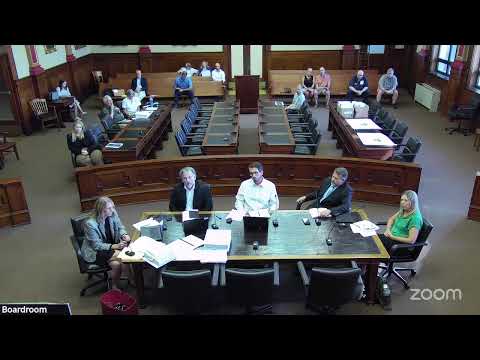
A Lee County zoning hearing on May 27, 2026 reviewed an application for the Prairie Broom Solar Project, a proposed 180-megawatt commercial solar facility sited in Alto and Reynolds townships. Hearing Officer Brian Brim recorded testimony from counsel and the project team and accepted exhibits into evidence before the public question-and-answer and comment periods.
Courtney Kennedy, local counsel for Prairie Broom Solar LLC, said the application seeks a special use permit and that the project was developed to comply with the Lee County solar ordinance and relevant Illinois codes. "The application materials reflect that commitment through the detailed site plans, the environmental analyses, the drainage protections, and coordination with local and state agencies," Kennedy told the hearing.
Project witnesses described the project as approximately 1,816 acres with a buildable footprint of about 1,524 acres, a fenced area of roughly 152 acres, an estimated 347,000 solar modules and 60 inverters. Adam Samansky, the project's director of development, said the design includes ordinance-required setbacks and a vegetative screening plan; he said the landscape plan will use an Illinois-required wildflower/pollinator seed mix across the project footprint and that screening trees are expected to be planted at 5–6 feet to meet an eight-foot target by year five.
Developers told the hearing a decommissioning study estimated removal and restoration costs at $15.5 million and outlined a financial-assurance schedule (10% funded at year one, 50% at year five and 100% at year ten). Donnie Dcastro, vice president of development, said the applicant will post required surety and comply with Illinois Agricultural Impact Mitigation Agreement (AMA) requirements to preserve topsoil, repair compaction and remove infrastructure at the end of the project's life.
The team detailed regulatory coordination: an IPaC consultation with the U.S. Fish and Wildlife Service after identification of an active bald eagle nest, wetlands delineation that identified 17 wetlands and two streams (to be verified by the U.S. Army Corps of Engineers), and commitments to a road use agreement, annual reporting to the county zoning administrator, noise-study adherence and coordination with local fire districts and first responders.
On mitigation and community benefits, external affairs director Anmarie Williams highlighted two-and-a-half years of outreach, an in-town office, a community grants program that has provided over $75,000 to more than 30 local groups, and a "Sun Initiative" offering a $50 annual electric-bill credit for Stewart residents for the first five years of operation.
County counsel and staff questioned the applicants about documentation in appendices (site plans, construction documents, noise and stormwater studies), fence and signage commitments, and a $100,000 deposit to the county consulting fund. Applicants confirmed they will bury on-site power lines where required, install required warning signage and post points of contact including a 24-hour number.
There was no final vote at the hearing. Hearing Officer Brim said he will draft a report and forward the record to the Lee County Board, which is the body with authority to grant or deny the special use permit. The hearing record remains open to the posting of the supplemental Natural Resources Information report the applicant may file within 10 business days, as allowed by the hearing officer.
Next procedural step: the hearing officer's report to the county board; the county board will set the final decision timetable.