Get Full Government Meeting Transcripts, Videos, & Alerts Forever!
Get email alerts on the Historic Preservation topic
No spam. Unsubscribe anytime.
Newbury Historical Commission returns demolition-delay application to building inspector, citing missing reuse description
Summary
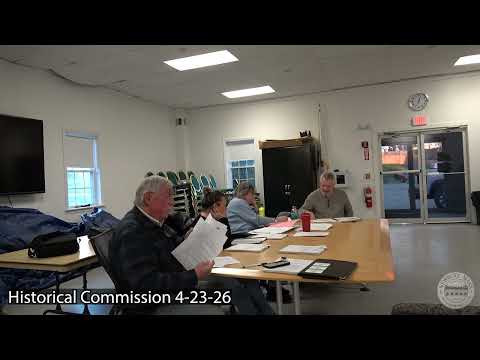
A special meeting April 23, 2026, ended with the Newbury Historical Commission voting to return a demolition-delay bylaw application to the building inspector after finding the filing did not adequately describe proposed reuse of the site.
The Newbury Historical Commission voted April 23, 2026, to return a demolition-delay bylaw application to the town building inspector, concluding the filing did not contain the required description of proposed reuse.
The commission’s chair said the application satisfied basic identification fields such as property address and owner contact information, but that the section requiring a brief description of proposed reuse — cited in the bylaw as section 4.1 (A–F) — was not met. The chair summarized the filing’s reuse statement as saying only that any future use would "be a municipal purpose consistent with municipal needs," and called that formulation insufficient.
Under the town’s demolition delay bylaw, applications must include the structure’s address, owner information, a description of the structure, a stated reason for demolition, and a brief description of proposed reuse or reconstruction. The chair read portions of the applicant’s supporting materials that allege persistent building deficiencies, including reported code violations, suspected ADA non-compliance and environmental hazards, and said those claims alone did not supply the missing reuse description. "So, the application is incomplete," the chair said.
A commission member moved to return the filing to the building inspector as inadequate; another member seconded the motion. The commission approved the motion by voice vote after brief procedural clarification that no further discussion or additional roll call was necessary.
Members noted that while the applicant stated the property was not being demolished for sale and has been vacant since 2016, the application provided no specific plan for what would replace or how any replacement would fit the character and grades of the neighborhood. Because that information is required under the bylaw, the commission directed the building inspector to request the additional details from the applicant.
With that action completed, the commission held a brief adjournment motion, which was seconded by Jan and carried by voice vote. The commission took no further substantive action at the special meeting.
The application will be returned to the building inspector for supplemental information about proposed reuse; the transcript does not specify a date for any resubmission or follow-up hearing.