Get Full Government Meeting Transcripts, Videos, & Alerts Forever!
Get email alerts on the Library Replacement topic
No spam. Unsubscribe anytime.
Hartford breaks ground on long‑planned Barber Street library replacement
Summary
Community leaders and residents celebrated a groundbreaking for a long‑planned replacement of the Barber Street branch in Hartford’s North End, with city and state funding — including a state library grant and Community Investment Fund support — bridging a final $5 million gap and construction slated to begin this summer.
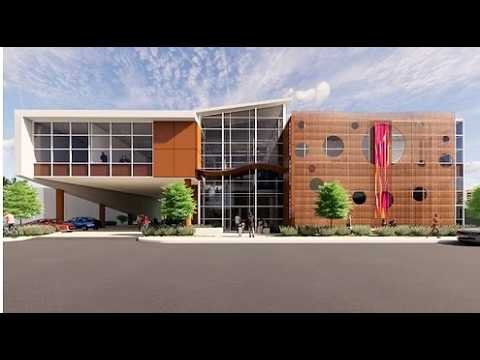
Community leaders, library officials and longtime neighborhood advocates gathered in Hartford’s North End to celebrate the groundbreaking for a replacement of the Barber Street branch of the Hartford Public Library.
Bridget Quinn, president and CEO of the Hartford Public Library, opened the ceremony and traced the project’s roots to a 2019 five‑year capital plan that named a Barber Street replacement as the library system’s top capital priority. ‘‘This is an event in years and years and years in the making,’’ Quinn said, thanking a long list of task force members, past board leaders and city staff who helped keep the project moving.
State Speaker Matt Ritter said the state’s Community Investment Fund (CIF) provided the roughly $5 million that closed the last funding gap and moved the project from delay to construction. ‘‘That $5 million, the difference between no more library for 10 years and shovels in the dirt today,’’ Ritter said, describing CIF as a bottom‑up bonding program created after the pandemic for community‑driven projects.
State Representative Miriam Khan, whose district includes the Barber Street site, said the new branch will serve as a neighborhood hub where children can come after school, adults can access computers and internet, and programs support literacy and job readiness. ‘‘Libraries are institutions that serve the community,’’ Khan said, emphasizing practical services such as internet access and air conditioning.
Karen Taylor, chair of the Hartford Public Library board, said construction is scheduled to begin this summer and described the new branch as a ‘‘new chapter’’ for the neighborhood with ‘‘robust programming’’ for multiple generations. Taylor credited past board members, task force volunteers and staff for repeated revisions that led to the project’s approval.
Mayor Arunan Arrolam framed the project as part of a broader neighborhood revitalization. He said the city committed about $9.5 million to the project and announced a separate $1 million investment aimed at supporting new small businesses and storefronts along Barber Street. The mayor also acknowledged a $2 million state library construction grant from the state library program.
Longtime local advocates emphasized the project’s symbolic significance after decades of effort. Steve Harris, chair of the Barber Street Task Force, recounted using the library as a child and praised the neighborhood’s persistence. Helen Nixon, a neighborhood leader, said residents had waited roughly 30 years for the moment and described the groundbreaking as a fulfillment of a long‑held promise to the community.
Organizers said the replacement branch is intended to be a multigenerational community hub for young people, families, job seekers, elders, artists and teachers, and to support neighborhood economic and social renewal. No formal vote or ordinance was recorded at the event; speakers marked the transition from planning to construction with remarks and ceremonial shovels.
Next steps: organizers expect construction to proceed this summer and to coordinate programming and ongoing community engagement as the project moves into the building phase.