Get Full Government Meeting Transcripts, Videos, & Alerts Forever!
Get email alerts on the Traffic Safety topic
No spam. Unsubscribe anytime.
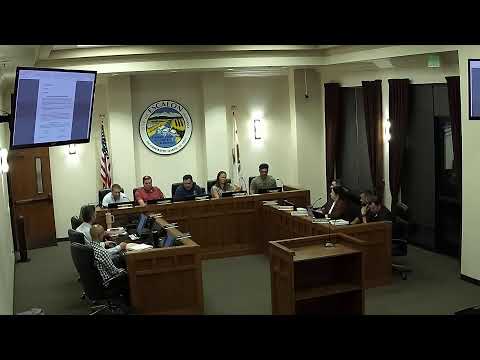
Council hears First Street speed data; staff say tickets yield little revenue compared with enforcement costs
Summary
Police presented radar-trailer data showing sustained speeding on First Street, especially at school start and evening commute times; staff said the city receives only a small share of base fines and that enforcement is time-consuming, prompting discussion of targeted enforcement and community reporting tools.
The council received detailed traffic data for First Street showing frequent speeding during school arrival times and evening commuter peaks. Police analyzed 13 days of radar-trailer data and reported that, during a sampled hour commonly associated with school, hundreds of vehicles passed the device and a notable fraction exceeded the limit: 342 vehicles were 6–10 mph over and 99 were 11+ mph over the posted limit across the sample period; the department estimated roughly a dozen to several dozen higher-speed incidents per day during peak windows.
Police and council discussed enforcement trade-offs: the city receives only the municipal portion of a base fine (the base fine for 1–15 mph over the limit is $35, with the city share of the base roughly $8–$9), while the full citation commonly carries more than $200 in state and county assessments. Officers noted that writing a ticket incurs officer time, record processing and possible court appearances; staffing and overtime for contested citations can make individual enforcement costly compared with the small direct revenue returned to the city.
The department said it lacks a dedicated traffic unit and instead responds to complaint-driven hotspots, using saturation patrols and motorcycle enforcement where possible. Council members suggested a mix of strategies: targeted, visible enforcement in school zones, regular scheduling of enforcement windows, resident complaint email boxes to centralize reports (a suggestion the council asked staff to consider adding to the city website), and a marketing/notification approach to deter nonresident “cut-through” commuter traffic.
City staff cautioned that enforcement will reduce speeding but may not be revenue-positive; council signaled interest in a coordinated enforcement plan aligned with school schedules and public information campaigns to maximize safety benefits.