Get Full Government Meeting Transcripts, Videos, & Alerts Forever!
Get email alerts on the Law Enforcement topic
No spam. Unsubscribe anytime.
FBI Director Kash Patel credits field-focused reforms, international fraud takedowns and AI triage for recent results
Summary
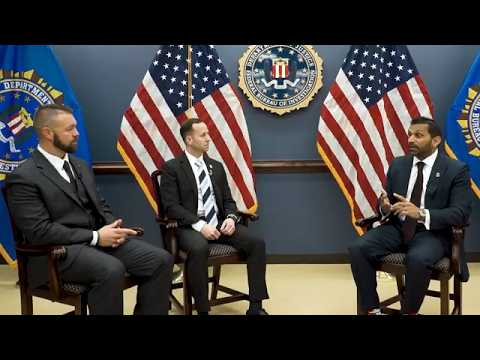
At an interview during National Police Week at FBI Headquarters, Director Kash Patel described workforce shifts that placed agents and analysts in field offices, cited declining murder rates and major narcotics and fraud seizures, and outlined expanded use of AI and community tips to prevent threats.
FBI Director Kash Patel outlined what he called a series of enforcement and organizational achievements during an on-camera interview at FBI Headquarters during National Police Week in Washington, D.C. He said the Bureau has pushed agents and intelligence analysts into field offices, tightened partnerships with state and local law enforcement and conducted international fraud takedowns.
"We dropped the murder rate 20 points," Patel said, and credited administration priorities and pushed resources for the results. He also said the FBI removed eight people from its Top Ten Most Wanted list in roughly 13 months, contrasting that with a prior four-year period when, he said, the Bureau removed four. Patel described a large fentanyl seizure with the transcript noting the phrasing "22 or 2,300 kg" and said fentanyl quantities seized represented a 31% increase year over year and — as he stated it — were "enough to kill 178 million Americans." He also said the Bureau located about 6,300 missing children, which he called nearly a 30% increase from a previous period.
On national security, Patel said arrests of alleged foreign intelligence and espionage actors were up 44% from 2024, naming China, Russia and Iran as sources he believes were involved in attempts to steal U.S. secrets. He linked those operations to both national security and economic protections, saying perpetrators sometimes sought nonmilitary information such as agricultural data.
Asked how the Bureau sets priorities, Patel said the administration has clearly laid out priorities and described a management shift that moved roughly 1,000 agents and 300–400 intelligence analysts out of Headquarters into field offices so that intelligence would "drive operations" from local areas. He said the change reduced bureaucratic delays and let Special Agents in Charge assume responsibility for task-force staffing and operations.
Patel described personnel and clearance reforms intended to speed joint task-force staffing: clearing a backlog of about 650 task-force officer onboardings (which he said went from a 12‑month wait to a zero backlog) and capping new onboarding at 60 days for certain roles, along with using Secret-level rather than Top Secret-level clearance in some cases to expedite participation.
Patel detailed recent fraud operations the FBI led abroad: a multiagency operation in Dubai he said resulted in about 300 arrests, freed roughly 2,000 trafficking victims and shut a scam center he described as a $4 billion operation; earlier work in Southeast Asia and a separate case he described as a $15 billion crypto fraud tied to an entity he named the "Prince Group". He also described a quarter‑billion‑dollar disruption ("$250 million") of fraud tied to a program he called "Feeding Our Futures" in Minnesota. Patel characterized fraud takedowns and dismantling of overseas scam compounds as a major priority alongside domestic counter-narcotics and counterterrorism work.
On technology and community engagement, Patel said the FBI has rebuilt intake infrastructure for tips and introduced AI into its National Threat Operations Center to triage incoming information. As an example, he said one AI-prioritized tip contributed to thwarting a school-shooting plot in North Carolina when triaged information was forwarded to state and local partners.
On training and recruitment, Patel said the Bureau reduced the Quantico agent pipeline to "100 days" for those seeking to become agents, increased National Academy class sizes to 300 from 250, and stood up a drone training program at Redstone Arsenal for state and local partners.
Patel repeatedly framed the Bureau's progress as restoring field partnerships and said those changes have improved morale among agents and state and local officers. He also defended the Bureau's record against media criticism and said efforts to depoliticize the agency included leadership changes at Headquarters and a renewed emphasis on supporting front-line law enforcement.
The interview ended with closing remarks and thanks from the host. The statements above reflect the Director's claims and descriptions as presented during the interview; many were made as numerical or programmatic assertions by Patel and were not independently confirmed during the segment.