Get Full Government Meeting Transcripts, Videos, & Alerts Forever!
Get email alerts on the Land Use topic
No spam. Unsubscribe anytime.
Planning commission declines to recommend Oasis at Indio specific plan to council after months of public testimony
Summary
After multi‑hour public comment focused on air quality, traffic and neighborhood impacts, the Indio Planning Commission voted 3–2 not to recommend the Oasis at Indio specific plan, EIR certification and related entitlements to city council and requested written findings for return at the next meeting.
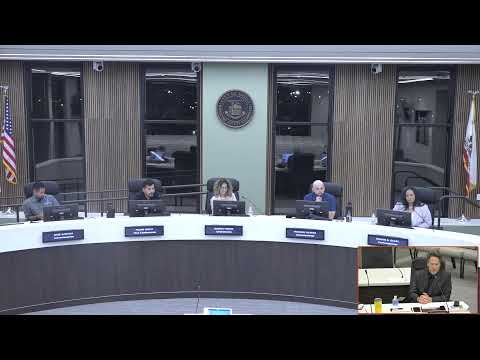
The Indio Planning Commission on May 27 declined to recommend the Oasis at Indio specific‑plan package to the City Council after an extended public hearing that drew dozens of residents and technical testimony from environmental and traffic consultants.
Staff asked the commission to make a recommendation on a package that included certification of a final Environmental Impact Report (EIR), a Statement of Overriding Considerations for unavoidable air‑quality and greenhouse‑gas impacts, rescission of earlier entitlements, general‑plan and zoning amendments, adoption of the Oasis specific plan, a development agreement, and a four‑lot financial tentative map. Staff’s presentation described an illustrative buildout that, in the project’s maximum scenario, could include up to 3,240 dwelling units, about 20,000 square feet of commercial space and roughly 1.8 million square feet of industrial space; staff and the applicant emphasized the package includes developer‑promised public benefits (5% affordable housing set‑aside, $3.5 million toward Monroe interchange improvements, 3 acres of parkland, public‑safety and medical clinic provisions and job‑fair commitments).
MSA Consulting, the EIR preparer, summarized the air‑quality and greenhouse‑gas analyses and said, using CARB/CAPCOA and SCAQMD guidance, that under a single‑phase worst‑case buildout some construction and operational pollutant thresholds (VOCs, NOx, PM10/PM2.5) would be exceeded. MSA said mitigation reduces several impacts but could not fully eliminate air‑quality and greenhouse‑gas exceedances under the worst‑case scenario; those two topic areas were identified as significant and unavoidable in the EIR, prompting a recommended Statement of Overriding Considerations.
Residents — especially neighbors from Sun City Shadow Hills and adjacent communities — spoke at length. Common concerns were diesel particulate matter and cumulative air pollution downwind of the site; traffic and emergency‑response delays at the Monroe interchange and on Avenue 42; proximity of large industrial footprints to the new Indio Sports Park and to neighborhoods; water and school capacity implications; and whether developer promises are enforceable. Several speakers cited the EIR’s own finding that air‑quality and GHG impacts are significant and not fully mitigable.
Applicant teams and consultants reiterated that the EIR studied a worst‑case buildout and that project phasing, mitigation measures and development‑agreement commitments would reduce on‑the‑ground impacts; the applicant said data centers are prohibited under the proposed specific‑plan land‑use matrix and that infrastructure improvements would be required before occupancy of development phases.
Commissioners then debated whether to recommend the package to council. Commissioner Slater summarized central objections: a permanent change in corridor identity, approval of unavoidable air‑quality and greenhouse‑gas impacts that he judged disproportionate to the benefits, and a fixed industrial entitlement that did not change between project scenarios. Commissioner Slater concluded: “I cannot make the findings necessary to recommend approval as is.” The commission voted to not recommend the package to council and directed staff to return with written findings for the next meeting (city staff indicated the commission will need to provide findings at the June 10 meeting).