Get Full Government Meeting Transcripts, Videos, & Alerts Forever!
Get email alerts on the Sewer Project topic
No spam. Unsubscribe anytime.
Paradise sewer plan faces renewed scrutiny as council and residents press for cost and O&M clarity
Summary
Assistant town manager Mark Maddox told the council the Paradise Sewer Project is at a technical decision point — a potential Clark Road treatment site and choices between membrane bioreactor (MBR) systems or surface discharge will determine costs and permit needs. Residents warned projected operating costs could make sewer hookups unaffordable without subsidies; council asked staff for clearer O&M, hookup and rate projections before any formal rate-setting.
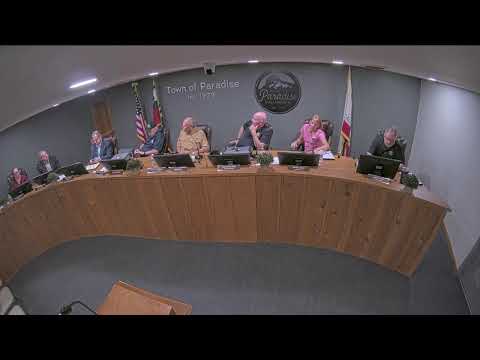
Assistant Town Manager Mark Maddox said May 12 that the Paradise Sewer Project has progressed to subsurface investigations, topographic surveys and hydraulic-model updates, and that the town will soon know whether a Clark Road site is technically feasible as a treatment location. "If it is possible, that can be explored further," Maddox said, describing a decision tree that could lead to either a membrane bioreactor (MBR) approach or a surface-water discharge option — each with different permitting and operating-cost profiles.
Residents at the meeting and council members pressed for concrete numbers. Councilmember Lang and others repeatedly asked when the town would have rate and operations-and-maintenance (O&M) projections that could feed a Prop 218 rate process. Maddox answered that the town would be able to update a conceptual rate analysis once preliminary (30%) design is complete and that USDA affordability criteria (2% of median household income) remain a constraint on funding and rate-setting.
Public commentators gave technical and financial objections to some collection alternatives and warned of household-level impacts. Cliff Jacobson, a local resident and sewer consultant, argued against a conventional gravity trunk system for Phase 1 — citing low velocities, solids deposition, corrosion and the need for lift stations as reasons gravity would impose high long-term O&M and construction impacts. "The gravity option is the wrong tool for this town at this moment," Jacobson said, urging step systems and MBR technology instead.
Other public commenters warned that even if capital subsidies are found, large O&M bills could make monthly sewer charges unaffordable for low-income households. One commenter cited a local estimate that similar systems can cost $2.5 million a year to operate and asked whether the town would be imposing rates that could force long-term residents to leave. "If this project goes full in fifth gear you will be moving people out," one resident said.
Council members sought assurances staff will present: (1) a clearer accounting of phase-one hookup counts under alternative plant sites and technologies; (2) modeled O&M scenarios for evaporation-pond, step-system and MBR approaches; and (3) updated rate projections tied to a 30% preliminary design milestone so council and the public can evaluate affordability and Prop 218 steps. Maddox said staff will continue monthly updates and expects more detail within weeks on the Clark Road feasibility work.
What happens next: staff will report back with feasibility results from the Clark Road desktop and subsurface investigations, then refine the rate and funding strategy if a feasible site and treatment alternative are identified. No final rate or design decisions were made at the May 12 meeting.