Get Full Government Meeting Transcripts, Videos, & Alerts Forever!
Get email alerts on the Economic Development Data Centers topic
No spam. Unsubscribe anytime.
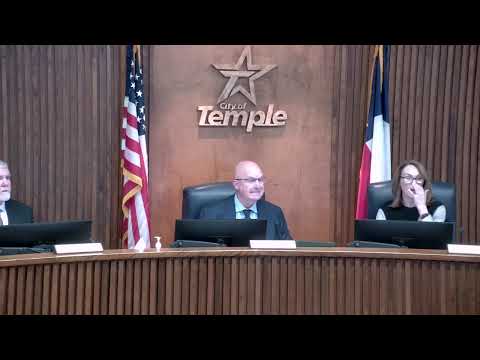
Temple council approves first reading of tax‑abatement zone for Rowan amid residents' demands for audits and water limits
Summary
After an hours‑long public hearing March 19, the Temple City Council approved on first reading a Tax Abatement Reinvestment Zone for Rowan Temple LLC covering roughly 270 acres in Synergy Park. Residents pressed for audits, escrow protections and clarity on water use; staff cited contractual limits and monitoring.
The Temple City Council on March 19 approved on first reading an ordinance creating a Tax Abatement Reinvestment Zone (TARZ) that staff says will cover roughly 270 contiguous acres in Synergy Park and automatically include future Rowan Temple LLC projects under a prior economic‑development agreement.
The measure, which passed 5–0 on first reading, would make qualifying Rowan investments eligible for a 50% abatement on increases in taxable value if the developer meets minimum commitments that staff described as at least $700 million in capital investment and the creation of 40 full‑time jobs in the designated area.
Why it matters: Residents pressed council members repeatedly during a lengthy public hearing about the project’s local impacts — especially water use, transparency and who is accountable if a tenant fails. Multiple speakers asked the council to pause further approvals until independent audits verify developers’ claims about electricity and water consumption and until contracts are made public.
“It's time to audit Meta and Rowan's claims before they start production,” resident Nell Brindley told the council during public comment, urging a temporary halt to data‑center projects until independent reviews are completed.
Council and staff responses: Ms. Thomas, the city staff member who presented the TARZ proposal, described the zone as a tool the city uses under Chapter 312 of the tax code to attract “major investment” and said Rowan has proposed at least $700 million in investment. Ms. Thomas also said the TARZ would let the city enforce investment and job‑creation commitments: “If they do not meet the minimum capital investment or job creation numbers, the tax abatement is void, and they do not receive the benefit of the tax abatement agreement,” she said.
On water and operations, city officials explained contractual limits the council will enforce. City presentations and staff answers during the hearing said the Rowan project’s water agreement allows a one‑time fill of up to 1–2 million gallons for a closed‑loop cooling system and sets a separate, hard contractual cap of 4,000 gallons per day for domestic (nonindustrial) use for the project as a whole. City staff said industrial or process water that would be treated and returned to the environment must meet the city's standards before it is discharged and that an advanced metering arrangement will provide near‑real‑time monitoring.
Residents raised multiple practical concerns: who pays for remediation if a leak or contamination occurs, whether Rowan or a tenant is responsible for treatment, whether Rowan places funds in escrow to cover remediation or remediation bonds, and whether the city has validated the companies’ financial capacity and technical claims. “Who holds everybody accountable? How do we know who’s even coming in?” asked resident Allen Liddell during the hearing.
The councilate process: Staff told the council that Rowan is primarily a developer that builds the shell of data‑center facilities and typically leases space to operators; staff said a failed tenant in an earlier Temple project (a Bitcoin operation) did not equate to Rowan’s business failure and that contractual obligations remain with the developer in the city’s agreements. City staff said the TARZ designation does not in itself obligate the council to approve future plats or site plans — it only makes certain investments within the geographic zone eligible under the existing economic‑development framework.
What the ordinance does and what it doesn't: The TARZ designation gives the city the legal mechanism to offer an abatement if Rowan meets the agreed investment and job targets. It does not guarantee specific tenants nor change other zoning or permitting requirements. Staff emphasized that the city can enforce compliance annually and through audits of investment invoices and operations.
Next steps: This was the ordinance’s first reading; the council approved the first reading and public hearing was closed. Staff and council members said further steps — any final ordinances, specific site plans, and construction‑phase approvals — will return to council for formal action. Residents who asked for more transparency said they will continue to press the city for public town halls and for publication of the underlying agreements and monitoring data.
Council vote/outcome: Item six passed on first reading by a 5–0 vote. The council will consider subsequent readings and any implementing agreements at later meetings.