Get Full Government Meeting Transcripts, Videos, & Alerts Forever!
Get email alerts on the Municipal Budget topic
No spam. Unsubscribe anytime.
Hatfield Borough previews $8 million 2026 draft budget, weighing small tax and fee increases
Summary
Hatfield Borough officials on Nov. 5 reviewed a draft 2026 budget of roughly $8 million, citing electricity costs, police contract increases and debt service as primary drivers. Options to close the gap include a 0.25-mill real-estate tax (~$35,000), raising electric customer fees and modest sewer fee increases; officials also flagged capital work on poles, ADA ramps and Heritage Park Pond investigations.
Hatfield Borough officials presented a draft 2026 budget at a fall town-hall on Nov. 5 that projects roughly $8 million in revenues and expenditures and seeks modest revenue and spending adjustments to close projected gaps.
Manager Snider said the drop from 2025’s approximately $11 million budget to about $8 million in 2026 largely reflects that the $2.9 million utility-replacement project is not repeated. "We're looking more at an $8 million budget," Snider told residents, adding that typical annual budgets in recent years fall in the $8–$9 million range.
Why it matters: officials said the borough still faces rising costs for purchased electricity (a net $77,000 increase reflected in the draft), ongoing debt service (about $500,000 projected for 2026 after a $2.5 million paydown in 2025) and a $50,000 annual increase in the police contract. Those pressures informed committee proposals to spread impacts between modest revenue changes and use of reserves.
Key cost drivers and capital priorities Steve Fickard, public works director and electric superintendent, summarized recent capital work and 2026 priorities. He highlighted the completed Broad Street/North Main utility replacement (including roughly 4,100 linear feet of storm pipe and roughly 2,000 linear feet of water main), roadway resurfacing projects and ongoing pole replacement work. Fickard said about eight poles were replaced this year and the draft includes $100,000 for pole replacement in 2026, up from $60,000 in 2025; staff said a grant application could offset a portion of that cost.
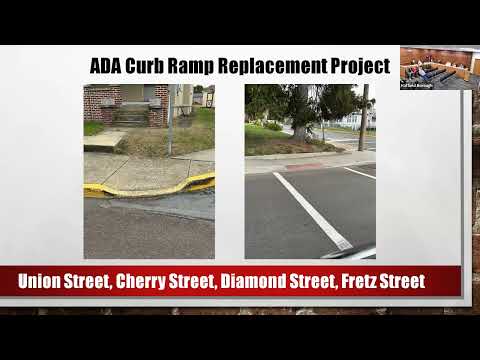
Officials flagged an ADA curb-ramp program (about 14 ramps anticipated) and continued work on Heritage Park Pond. On the pond, Fickard said the borough will televise a storm sewer run into the retention basin to locate leaks and will partner with a watershed group on grants and remediation planning.
Energy and peak-shaving Snider and Fickard credited a behind-the-meter diesel generator with reducing peak charges. According to the presentation, PJM/peak-related costs spiked in 2024 but the generator and other measures reduced the borough’s exposure; staff said 2026 electricity purchase costs are expected to rise by roughly $77,000 rather than the much larger increase that had been projected without peak-shaving measures.
Revenue and balancing options To narrow the 2026 gap, the budget finance and labor committee recommended a mix of actions rather than a single large increase. Proposals presented to the public included: - A 0.25-mill real-estate tax increase, estimated to generate "a little over $35,000" and add about $2.92 per month (roughly $35.14 per year) for the average property owner; - Raising the electric customer charge from $15 to $18 per month (estimated to add about $53,280 in revenue, about $36 per year for an average residential customer); - Increasing the quarterly sewer flat fee by $5 (estimated to add about $36,200).
Manager Snider also described an interim savings step: ordering select 2026 materials and equipment late in 2025 (LED fixtures, pond televising, camera replacements) to realize roughly $29,250 in 2026 savings.
Other revenue notes included expected year-end EIT of roughly $550,000 (staff reported $477,000 as of mid-November) and LST near $47,000 so far; the second half of an EDU sewer audit is expected to add about $77,000. Officials said they were prepared to use some reserves or investment proceeds to reduce the burden on residents if necessary.
Public feedback and operational items Residents raised service and operational concerns during the town-hall. A resident who identified himself as Juras described difficulty interpreting his electric bill and said he had to "subtract bill one from bill two" to understand usage; staff acknowledged the bill format and said correcting the display would require a programming change. The borough also reported it considered a single trash hauler but, after public input opposed that approach, will keep the existing system that allows residents to choose haulers.
On emergency services, residents asked about false alarms and volunteer staffing for the volunteer fire company. Officials said call logs are reviewed at council meetings and noted that volunteer recruitment pressures could increase costs if paid staff were required in the future.
What’s next Officials emphasized the draft status of the budget: it is not final and will be discussed at upcoming council meetings in November and December, with a target adoption date of Dec. 17. Residents were invited to comment by email or at council meetings.
"We want to do what's best for all 3,300 residents of this municipality," Mayor Gerard said during closing remarks.