Get Full Government Meeting Transcripts, Videos, & Alerts Forever!
Get email alerts on the Municipal Governance topic
No spam. Unsubscribe anytime.
Traverse City Commission approves multiple parking orders, infrastructure contracts and intergovernmental agreements
Summary
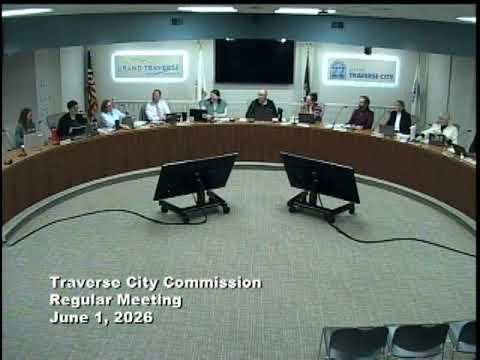
At its June 1, 2026 meeting the Traverse City City Commission approved a consent calendar and several routine and infrastructure actions, including traffic control orders on State and Bay streets, contract extensions for cross-connection inspections, water-main preliminary design contracts, a year‑one membrane replacement agreement, and an MS4 public‑education collaboration.
Traverse City’s City Commission on June 1 approved a series of routine and infrastructure measures intended to clear the way for summer events and advance planned capital work.
The commission adopted the consent calendar (as amended) and approved two traffic control orders. One (TCO 756) restricts parking within 15 feet of the South Cass and East State Street intersection (northwest corner) and was adopted after a short debate about whether the motion’s language calling the order “permanently adopted” could create confusion if the commission later changes State Street’s traffic direction. Staff and the city attorney explained that traffic control orders can be rescinded and are needed to legally support traffic devices; the roll-call vote recorded a majority in favor and the motion passed. The commission also approved a separate order clarifying overnight-parking and increased-fine signage for Bay Street during the National Cherry Festival; Nicole Vines, the city’s parking director, said the increased fines apply only to Bay Street and that other city limit signs will not show doubled fines.
The commission authorized several contracts and contract extensions. It approved a three‑year extension with CCRA Professional Services for cross‑connection control services at an amount not to exceed $59,904 annually; Art Krieger, the city’s director of municipal utilities, said contractors will wear identification, send advance letters to neighborhoods and that residents can refuse entry. The commission also authorized preliminary design and geotechnical agreements for the Brownfield Water Main and Street Reconstruction project, with a not‑to‑exceed engineering design authorization of roughly $206,839 (including a 15% contingency) and geotechnical services not to exceed about $30,879.73; staff noted approximately $1,000,000 in Brownfield funding is available for the project.
On wastewater infrastructure, the commission approved an out‑of‑scope, year‑one professional services agreement with Jacobs for membrane replacement work in an amount not to exceed $1,190,460.81 and waived competitive bidding for that first-year agreement. Staff said year‑one work is heavily weighted toward necessary replacements and that the project is expected to yield operational benefits, including roughly $79,000 of annual electricity savings once improvements are realized.
The commission approved an intergovernmental agreement to collaborate with the Grand Traverse County Drain Commissioner on MS4 public education. City staff said the city already has a stormwater public education plan (submitted to EGLE) and that communications staff will lead messaging while coordinating with the drain commissioner and local watershed partners.
Other actions taken included enactment of ordinance amendments to require special‑land‑use review for auto‑centric uses and to allow municipal markets in the Open Space district; authorization to execute fireworks permits for July 4 and July 11 for the Boom Boom Club and the National Cherry Festival; and direction for staff to continue facilitated talks over future uses of the Carnegie Building, with a report back by Sept. 8, 2026.
Where motions required no immediate policy change, commissioners generally directed staff to continue work and return with more detailed recommendations (for example on State Street configuration and short‑term rental recommendations). The commission’s next steps on several items include further staff reports and, in some cases, review by the Complete Streets Advisory Committee or joint sessions with the Planning Commission.