Get Full Government Meeting Transcripts, Videos, & Alerts Forever!
Get email alerts on the Cpted topic
No spam. Unsubscribe anytime.
Police outline CPTED strategies, propose small-business grants to shore up safety
Summary
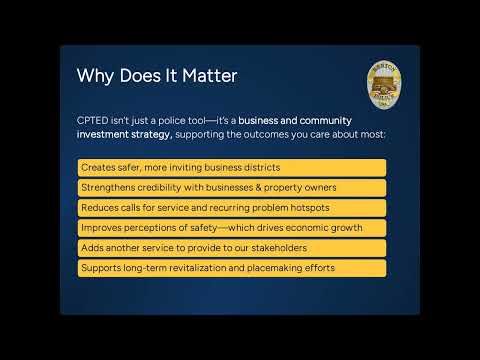
Renton police presented Crime Prevention Through Environmental Design (CPTED) principles—access control, natural surveillance, territorial reinforcement, maintenance and social management—and proposed a possible CPTED grant to help small businesses pay for lighting, glass repair or other security measures.
Sandra Havlik, a 16-year police department staff member and the city’s CPTED advisor, told the Committee of the Whole that CPTED—Crime Prevention Through Environmental Design—uses design, maintenance and community activation to reduce crime and calls for service. "If we can make a space more visible, we can do that several ways," Havlik said, describing access control, "eyes on the street" natural surveillance and territorial reinforcement such as signage and gates.
Havlik listed low-cost steps that can change perceptions of safety and deter unwanted activity: trimming shrubs to maintain 25–30-foot sightlines, keeping tree canopies higher than pedestrian sightlines, adding natural light and glass in parking structures, and rapid graffiti abatement. "We really have a rule about graffiti that it should be cleaned up within 24 hours," she said, noting the department assists business owners when possible.
The presentation highlighted programs the police already provide: free security surveys, plan review comments on city-permitted projects, educational CPTED checklists for residents and businesses, and CPTED trainings for staff and officers. Havlik said she serves as a CPTED advisor on city projects and sits on regional CPTED training efforts; she also described how activation—farmers markets, pop-ups and multiuse development—can bring intended users into spaces to discourage negative activity.
Councilmembers asked how the department coordinates with code enforcement and public works. Havlik said she often teams with code enforcement and patrol, performs joint site visits and offers tenant safety meetings. She described strip malls as a recurring challenge and said multiuse development with ground-floor retail and upper-floor housing improves natural surveillance because residents provide ongoing presence.
On funding, Havlik proposed a small CPTED grant program run through economic development—modeled on programs in other Washington cities—to help small businesses repair windows, add lighting or install bollards after a crime. "If we had a CPTED grant ... they could apply for it," she said, adding that the chief supports exploring program designs and that staff would provide examples from Tacoma and Seattle.
The committee did not vote on any ordinance or resolution during the presentation. Councilmembers thanked Havlik for the briefing and raised follow-up topics including residential eligibility for grants, how CPTED will be incorporated into staff onboarding and how to scale training for parks and maintenance crews.
The committee moved on to the next agenda item after the discussion; no formal action on a CPTED grant was taken at this meeting.