Get Full Government Meeting Transcripts, Videos, & Alerts Forever!
Get email alerts on the Agriculture Containers topic
No spam. Unsubscribe anytime.
Planning commission defers proposed rules to allow shipping containers for agricultural use
Summary
Beaufort County planning staff proposed text amendments to permit shipping containers for bona fide agricultural uses with proof requirements and screening; the commission deferred the item to tighten wording on tractor‑trailer exclusions, hazardous materials, screening distances and inspections.
The Beaufort County Planning Commission deferred action on proposed text amendments (case CDPA 000057‑2025) that would allow shipping containers to be used for bona fide agricultural purposes, citing the need for clearer limits and enforcement language.
Rob (planning staff) told the commission the draft removes a previous numeric cap on containers (for example, the prior ‘‘1 per 5 acres’’ rule) after feedback from the Farm Bureau and instead concentrates on measurable proof that an operation is agricultural, such as a Schedule F from a recent tax return, a Beaufort County non‑timberland agricultural tax exemption, or a USDA farm number. He said the change reflects a variety of legitimate farming uses for containers — from equipment and seed storage to hydroponics and mushroom cultivation — and that staff tightened screening and other requirements to address visual impacts.
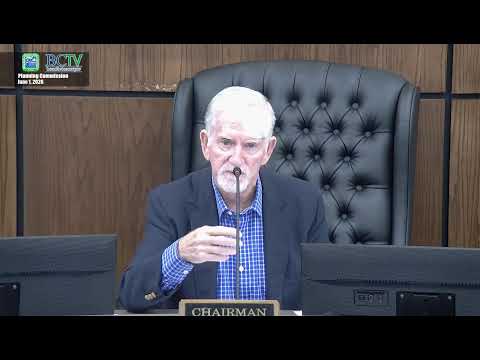
The commission pressed staff on enforcement and on preventing misuse. The chair warned the code could become ineffective without enforcement, saying enforcement generally relies on the county’s code‑enforcement office and public complaints. Commissioners asked staff to clarify that exemptions apply only to shipping containers and not to tractor‑trailers or semi‑trailers, and to make explicit that hazardous waste and storage of regulated toxic materials would be prohibited inside containers.
Public commenter Mary Connor questioned whether the proposed ‘‘proof’’ options would reliably demonstrate bona fide agriculture and warned of the possibility of container parks near residential areas. She also noted that hydroponic operators often use insulated ‘‘reefer’’ containers.
Commissioner Dennis moved to defer the item so staff can refine language; the motion was seconded and carried, with the chair announcing the item deferred until the next planning commission meeting. Staff said the revisions they will prepare include clarifying the tractor‑trailer exemption, tightening language on storage of explosive/flammable/toxic materials (explicitly prohibiting hazardous waste), increasing the screening requirement from 100 feet to 200 feet from a public right of way in some provisions, and addressing inspection language.
The deferral leaves the substantive policy questions — how to balance farm flexibility against neighborhood impacts and how to detect and address misuse — for another meeting, with staff directed to return with amended draft language.