Get Full Government Meeting Transcripts, Videos, & Alerts Forever!
Get email alerts on the School Finance topic
No spam. Unsubscribe anytime.
Medford officials lay out debt-capacity limits and tax impacts as high-school design narrows
Summary
City officials told the Medford High School building committee that, under three illustrative debt-exclusion scenarios ($440M, $532.7M and $607M), the city’s levy would carry a significant new charge that peaks in fiscal 2033, and urged the committee to right-size the project so a debt-exclusion question can pass.
Medford — City officials and the Medford Comprehensive High School Building Committee on June 1 walked members and the public through three illustrative debt-exclusion scenarios for a proposed new comprehensive high school and warned that other large municipal capital needs limit the city’s ability to absorb new debt without cutting scope.
Mayor Longo Kern, presenting with city finance and project staff, said the team met with the Massachusetts School Building Authority (MSBA) and learned the agency was “very supportive of our community building the building that we need it to be,” while also requesting the team provide alternate options for comparison, including a 9–12–only plan. The mayor said MSBA does not consider the request a constraint on the project’s approval path but wants options for comparison.
Why it matters: The city’s long-range debt model includes pension and retiree-health obligations, water and sewer infrastructure needs, a badly needed fire headquarters, and other capital projects. City staff told the committee that adding a large high-school debt exclusion could push the city close to its practical borrowing limits, making it harder to fund other projects without either additional voter approvals or rethinking scope.
Assessor Jared Yarian walked the committee through modeling assumptions — 2% annual new growth, 5% annual residential value growth and normal annual levy increases under Proposition 2½ — and showed how the three example borrowing levels would be added to the levy. He said the full tax effect on property owners would peak in fiscal 2033 and then gradually decline as growth and levy increases dilute the constant debt charge. The models presented three illustrative city shares: a low of about $440 million, a mid-case of $532.7 million and a high of $607 million.
City staff also emphasized other demands on the city’s borrowing: a roughly $96 million pension liability cited in the presentation, an estimated $70 million to finish lead-service-line replacement, recurring equipment and vehicle needs, a multi-million-dollar recreation-center waterproofing estimate, and a multi-year streets, sidewalks and water/sewer backlog.
Paul Riggy, the city’s facilities director, warned that a new, larger, fully electrified building could increase operating costs unless HVAC systems and life-cycle choices are carefully vetted; he urged the committee to consider long-term maintenance and utility impacts. “I really don’t want to see the city go the way of Lexington, who just approved their building and their superintendent was just faced with cutting 65 FTEES from the current upcoming budget,” he said.
Public reaction at the meeting was mixed: several speakers stressed the need to replace an aging building, while many urged the committee to reduce nonessential space or identify alternate funding to keep the owner share affordable. Michelle Barkson, a teacher, told the committee the debt exclusion mechanism is distinct from the city’s operating budget and staffing decisions, and asked what the committee and city would do to reduce project costs so a debt-exclusion vote could win broad support.
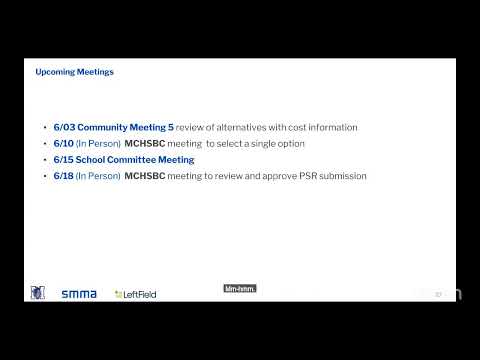
What’s next: The building committee is scheduled to vote on a single preferred option on June 10 and the project team plans to submit a Preferred Schematic Report (PSR) to the MSBA by June 25 to start the agency review process. The city and school team intend to pursue right-sizing work over the summer, present a plan to the public in September and finalize scope in October ahead of schematic design.