Get Full Government Meeting Transcripts, Videos, & Alerts Forever!
Get email alerts on the Public Transit Trolley topic
No spam. Unsubscribe anytime.
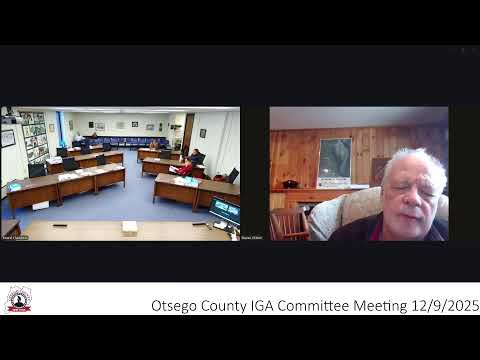
IG Committee weighs reissuing trolley RFP with one-year term and renewals
Summary
Otsego County staff told the IG Committee they can reissue an RFP for the village trolley in January but recommended a one-year contract with up to four one-year renewals (to reach five years) to give the village an off-ramp while preserving vehicle lifecycle benefits; DOT approvals and tight timelines make March committee review and April board action likely.
The Otsego County IG Committee discussed whether to reissue a public transit request for proposals for the village trolley, with staff recommending a one-year contract that includes up to four one-year renewals to effectively preserve a five-year horizon while giving the village and contractors an easier exit.
Tammy Harris, who introduced the agenda item, said the original RFP specified a five-year term and that the village lacks the financial capacity to commit to five years at current prices. She summarized the village’s proposal: "one-year term with four one-year renewals," which would allow an off-ramp if the service or contract performance proves unsatisfactory.
County staff said an RFP issued in January is feasible but tight. Nicole (staff) explained the schedule and approvals needed: issue the RFP in January, allow time for proposals and review, bring recommendations to the IG Committee in March, and seek board approval at the April meeting so the contract can be finalized in time for the 2025 season. Staff warned that DOT approvals and the review process could delay that timeline.
Committee members flagged two operational and financial risks: vendors may be reluctant to bid on a one-year contract despite renewal options, and initial ramp-up costs would be concentrated in year one if the vendor must onboard quickly. Tammy noted the trolley’s vehicles were purchased with federal funds and reach useful life timing that argues for a longer-term view: surplus proceeds from vehicle sales historically have sometimes exceeded the 10% local match and could be reconciled in the county–village agreement.
Harris described the county–village finance arrangement: federal and state funds (operating and capital) are applied to system expenses; if revenues (such as state operating assistance) exceed expenditures, the village documents its additional trolley-related expenditures and the county reimburses that amount. If expenditures exceed revenues, the village makes the county whole.
On outstanding questions, staff have asked DOT whether resale proceeds from surplus vehicles are restricted or if the county may apply a portion locally; Tammy said DOT guidance has not yet been received. Committee members said they support issuing an RFP tailored to the village (shorter term and scaled scope) and asked staff to proceed, noting the need to balance vendor interest with fiscal prudence.
The committee did not adopt a binding policy in the meeting but supported staff moving forward with drafting a one-year RFP that allows renewals and returning to IG with the procurement timeline and any DOT clarifications.
Next steps: staff will prepare the revised RFP for January issuance, monitor DOT guidance about surplus proceeds, and aim to present candidate proposals to the IG Committee in March for potential board action in April.