Get Full Government Meeting Transcripts, Videos, & Alerts Forever!
Get email alerts on the Procurement Billing topic
No spam. Unsubscribe anytime.
UI defends $1.3 million add-on netting build; staff questions lack of RFP
Summary
Authority staff questioned why United Illuminating used a legacy 2018 vendor rather than a competitive RFP for a billing-system add-on netting project that grew from early estimates to roughly $1.3M; UI said combining four billing changes into one vendor engagement reduced risk to billing accuracy and saved duplicative effort, and agreed to late-file supporting citations.
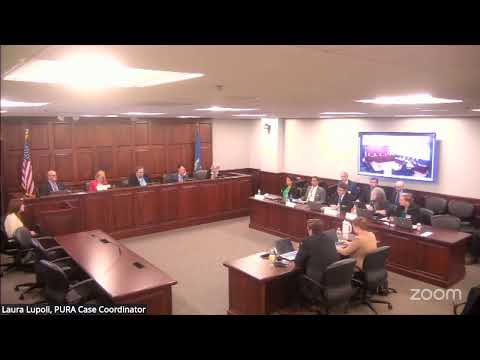
During cross-examination by Authority staff, Christopher Arpin drilled into UI's add-on netting implementation costs and procurement choices. The project, originally estimated in a prior docket at roughly $300,000, now appears across UI filings with higher totals (UI filings show components such as RES and multifamily affordable housing). Arpin asked where the company had been directed by PURA to meet a completion deadline that would preclude conducting a competitive RFP.
Katarina Miller and other UI witnesses responded that the company's original estimate covered a single component. The eventual effort combined multiple billing-system enhancements (add-on netting for RS and NRES, MFAH, and SAM phase 2) to avoid redundant interfaces and reduce testing risk in SAP billing. Miller said that the company used a vendor that had performed the initial 2018 billing-system integration and that the vendor's familiarity with UI's configuration reduced the chance of billing errors.
Arpin pushed on timing: the original motion authorizing some work was issued in May 2024 and one PURA order cited a January 2026 completion expectation; Arpin asked why a roughly 6'9-month RFP process would not have been feasible during that interval. UI witnesses and a company witness (Mr. Daniels) replied that bringing a new vendor unfamiliar with UI's billing configuration into complex, concurrent upgrades would increase risk; they said the legacy integrator provided continuity and efficiency for coordinated changes and that running a full RFP could have delayed implementation and increased potential for billing problems.
UI agreed to submit a late-file exhibit listing citations tying prior PURA motions and orders to the project timeline and to provide vendor-selection documentation requested by staff (late files 3 and 4). The Authority recorded several follow-up late-file requests to clarify the evolution of cost estimates, the scope of the combined work, and why the company considered vendor continuity the prudent path.
Why it matters: the add-on netting work touches customer billing systems; when costs materially increase from early estimates, regulators seek documentary support for procurement choices and reasonableness. Staff asked for additional record evidence to evaluate whether the decision not to run a competitive solicitation was justified given timetable, scope and cost growth.