Get Full Government Meeting Transcripts, Videos, & Alerts Forever!
Get email alerts on the City Budget topic
No spam. Unsubscribe anytime.
Bay City officials hear final budget presentation as ARPA funds wind down and sanitation rate smoothing proposed
Summary
City finance presenter Mr. Martini delivered the third and final review of the proposed 2026–27 budget, detailing fund-level changes, exhausted ARPA allocations, major street projects, brownfield and TIFF revenues, and a softened three-year sanitation rate increase plan meant to spread costs more smoothly for residents.
Mr. Martini, the city’s budget presenter, gave the Bay City Commission the third and final walkthrough of the proposed 2026–27 budget, focusing on funds outside the utilities and the general fund and flagging several one-time or exhausted federal allocations.
The presentation mattered because it outlines which capital projects and services the city can fund next year and how much of long-expected federal or grant revenue the city can realistically rely on. Mr. Martini said this presentation covered “all other funds besides the utility funds as well as the general fund” and noted most American Rescue Plan Act (ARPA) allocations for roads, lead-line replacement and sewer projects have been spent, leaving a little over $3 million remaining.
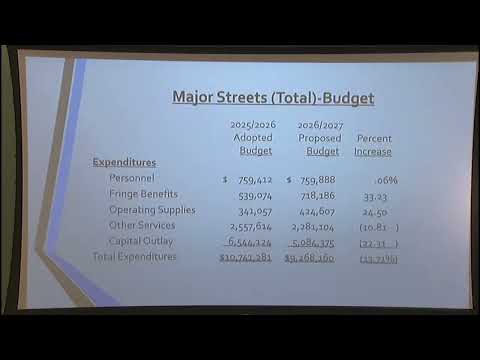
Mr. Martini walked commissioners through a long list of funds and line items: cemetery endowment transfers that fund Oakridge Cemetery maintenance, major- and local-streets revenues and projected transfers-in (including $400,000 from CDBG and $47,000 from Marquette TIFA), and capital outlays such as First Street reconstruction ($990,000), Henry Street ($1.5 million) and a signal replacement ($500,000). On brownfields and tax-increment financing (TIFF) programs, he said Uptown TIFF currently collects about $3 million and that debt service on the programs is comfortably covered through 2043.
Commissioners pressed for clarity on reimbursements tied to bridge work. Mr. Martini confirmed much of the Independence/Water Street bridge budget is reimbursed by Bay City Bridge Partners but noted some costs — for example, certain fringe-benefit expenses for the assigned bridge employee — are not reimbursable under the partner contract. Commissioners asked staff to make reimbursements and net city costs more visible in the budget book to avoid public confusion.
On sanitation rates, the commission discussed a recommendation to smooth a previously steeper increase across three years. Mr. Martini described a plan that spreads the increase so residents would see a roughly $2 increase in FY2027, then $2.28 in FY2028 and $1.53 in FY2029, instead of a large initial jump. Commissioners expressed support for the more gradual schedule as easier to communicate and less disruptive for residents.
The commission also discussed the community development block grant (CDBG) program, noting a roughly 25–26% cut in federal CDBG allocations and reallocations across emergency home repair, housing rehabilitation and sidewalk programs. Questions about the $1.6 million for a prior Lafayette line item were clarified: portions had appeared in earlier years’ budgets but none of the $1.6 million are assumed in the current proposed budget because the revenue never materialized.
The presentation closed with discussion of planned public-improvement projects the city has been saving for (Carol Park playground, marina docks matching state grants, crooked-bridge repairs) and a general reminder that some committed Bridge Partners dollars intended for local streets are not yet programmed into specific projects and will appear when candidate projects and grant matches are identified.
The commission took no final vote on the full budget at this meeting beyond adopting recommended minor amendments (see separate action), and staff said the numbers presented are those expected to appear in the official adopted budget resolution on June 15.