Get Full Government Meeting Transcripts, Videos, & Alerts Forever!
Get email alerts on the Transportation topic
No spam. Unsubscribe anytime.
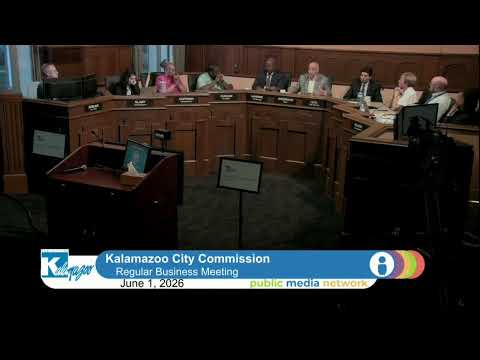
Kalamazoo commission approves MDOT-backed plan to convert Kalamazoo Avenue to two-way traffic
Summary
The Kalamazoo City Commission on June 1 approved contracts and an MDOT subrecipient agreement to begin a multi-year conversion of Kalamazoo Avenue from one-way to two-way traffic, accepting a $16.8 million MDOT agreement and awarding a $2.14 million construction‑engineering contract; the estimated total project bid is about $19.6 million.
The Kalamazoo City Commission voted unanimously June 1 to accept a Michigan Department of Transportation subrecipient agreement that will fund a major, multi-year conversion of Kalamazoo Avenue from one-way to two-way traffic and to award a construction‑engineering contract to Whiteman Associates.
Director of Public Services James Baker told the commission the MDOT agreement is written for $16,808,308, while the city’s bid tab sums to roughly $19.6 million. He said about one-third of that amount — a bit more than $6 million — is utility work paid by enterprise funds for new water and sewer infrastructure, and roughly $8 million of the above-ground work is federally grant-funded. The Whiteman Associates contract for construction engineering and inspection is for $2,139,900.
"This is kind of the door to door, where the shovel meets the ground," Baker said, explaining Whiteman’s role as the day‑to‑day owner’s representative overseeing quality control, materials testing and contractor coordination. He told commissioners the design work dates to earlier corridor and MDOT studies and that construction will be staged over about three years.
Why it matters: the work replaces some water mains dating to the 1890s, rebuilds storm and sanitary sewer in places and converts traffic movements and on‑street parking to accommodate two-way flow, center left-turn lanes and protected bicycle lanes. Officials said the project is intended to improve safety and long-term utility reliability as well as open new mobility options downtown.
Commissioners pressed staff on costs and scheduling. Baker acknowledged that an engineer’s estimate produced the $16.8 million MDOT agreement but that bids came back higher; he said the unit prices in the MDOT contract are fixed, but the final total will vary depending on actual quantities placed in the ground. "Most of the changes that will be brought forward… are going to be quantity-driven," he said, citing potential adjustments for additional storm or sanitary work discovered during construction.
Commissioner Praedel asked whether the city could proactively lock in material prices to reduce overruns; Baker said unit prices are now fixed on the contract and that the larger difference arose from phasing and material‑price changes between the engineer’s estimate and the bid. He emphasized the city had intentionally written construction‑phasing requirements to limit closures and protect local businesses, which raises construction costs but reduces neighborhood impact.
Several residents raised neighborhood concerns during public comment and Q&A. Emma Beatty of the Edison neighborhood pleaded for speed bumps near her home to protect children, saying, "I'm begging you. Please. We need those three speed bumps," and asked staff to follow up with specific locations. Baker and other staff said speed‑bump and traffic‑calming plans are part of the neighborhood response and that the city will deploy some speed bumps this year in Stewart and the Northside.
Staff outlined community outreach plans and said a more detailed construction schedule and public‑communication plan will return to the commission on June 15. Baker said the city is working with arena developers and others to reduce event‑day conflicts; the new arena is scheduled to open in fall 2027 and construction will overlap some arena activities.
The commission approved the Whiteman Associates construction‑engineering contract and adopted the MDOT subrecipient agreement on roll call votes with all members voting yes. City staff said they will return with a more detailed sequencing plan, monitor contractor performance and bring any change orders to the commission in accordance with city policy.
Next steps: staff will present a construction sequencing and communications plan on June 15 and begin contractor coordination and advance work if award documents are finalized.