Get Full Government Meeting Transcripts, Videos, & Alerts Forever!
Get email alerts on the Municipal Budgeting topic
No spam. Unsubscribe anytime.
Hope Mills finance director says $22.5M budget is balanced but ‘not sustainable,’ urges rebuilding reserves
Summary
Finance Director Britney presented a balanced $22.5 million FY26–27 budget that avoids a tax increase but relies on one-time ARPA funds and depleted reserves; she urged the board to rebuild fund balance and consider revenue or structural changes. The board asked staff to model tax and compensation scenarios and scheduled a follow-up work session.
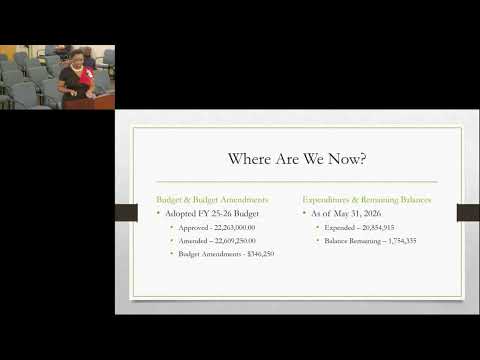
Britney, Hope Mills’ finance director, told the Board of Commissioners on the first night of June that the proposed $22.5 million fiscal 2026–27 budget is balanced but not sustainable.
"The budget before you is balanced. However, the larger question is whether it is sustainable," Britney said, warning the board that the presented plan depends on a one-time ARPA transfer of $653,000 and a fund-balance appropriation of $423,000 and that reserve levels remain below the town’s adopted targets.
Britney outlined structural concerns driving the risk: personnel and benefits represent roughly 66% of the general fund, public safety operations account for about half of general fund expenditures, and deferred capital such as aging fleet vehicles has increased maintenance costs. She said administration received roughly $2 million in departmental requests but recommended funding about $125,000 of that total in this draft.
The finance director summarized key recommendations from the State Auditor’s Office that have budgetary impact: establish minimum unrestricted reserve thresholds; develop a plan to restore reserves lost in 2025; limit reserve usage to board‑approved capital projects; require financial analysis for mid‑year expenditures and budget amendments; and tighten travel and reimbursement controls.
To limit ongoing dependence on one‑time funds, Britney urged maximizing year‑end carryforward, reviewing discretionary line items (events, committee budgets, travel and supplies), and considering competitive rebidding of contracts. She proposed several small, near‑term savings ideas but cautioned they would not resolve long‑term structural gaps.
She also presented revenue scenarios for incremental property tax increases. A 1‑cent increase would yield minimal relief; 2 cents would bring in about $418,000; and 3 cents about $627,000, which Britney said could materially reduce reliance on ARPA and help replenish reserves.
The board pressed for clarity on options. Commissioner Marley thanked Britney for the presentation and asked directly whether a tax increase is necessary to avoid further service cuts, saying the board needs a candid answer about whether the town can be run without raising revenue. Several commissioners and the mayor recalled past choices to delay reserve replenishment and noted mid‑year public safety expenses (school resource officer staffing and associated equipment/vehicles) contributed to the current shortfall.
On compensation, the board debated how to prioritize cost‑of‑living adjustments (COLA), merit pay and small equity/certification buckets. Options discussed included a 3% COLA with no across‑the‑board merit, and a 2% COLA with a 1% merit pool; staff and HR were asked to model scenarios and return numbers quickly.
Next steps: the board directed staff to produce detailed scenario numbers for the compensation and tax options and to provide printed contract worksheets for review. Commissioners set a follow‑up work session at 5:30 p.m. next Monday to review contracts, staff positions and a budget recap before the 7 p.m. public hearing.
The presentation framed the immediate choice plainly: preserve services by identifying sustainable revenue or make deeper cuts that could reduce service levels to residents. Britney closed by emphasizing she is presenting options, not advocating for a particular outcome, and that the board still has several choices if it acts now.