Get Full Government Meeting Transcripts, Videos, & Alerts Forever!
Get email alerts on the Open Meeting Law topic
No spam. Unsubscribe anytime.
Executive committee debates open-meeting law changes, agrees to bring draft physical-location policy to full commission
Summary
After state open-meeting-law changes, the executive committee discussed whether the commission and its committees are 'non-advisory' and the operational impacts of requiring a staffed physical location; members voted to send a proposed policy (physically staffed location and preference for workday hours) to the full commission in August.
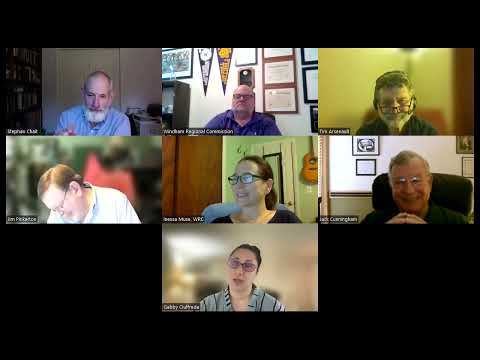
The Windham Regional Commission’s executive committee spent a large portion of its meeting discussing recently changed state open-meeting requirements and their operational impact on commission committees.
Staff summarized the legal change: bodies with budgetary authority are likely treated as non-advisory under the revised rule set and therefore must provide a staffed physical location for hybrid meetings. Commissioners debated whether that requirement must apply to every committee or only to those with budget authority. Some members urged a conservative, uniform approach across the commission to reduce confusion; others emphasized the disproportionate burden this places on small town committees and the operational costs when staff must be physically present.
The conversation focused on staff safety and meeting timing. Several commissioners argued that having staff come to a physical office for evening meetings raises safety concerns and can impose childcare or workload burdens on staff; others noted that shifting meetings into daytime hours could increase staffing costs because two staff sometimes must be present. One commissioner summarized the conservative reading of statute: “Our Regional Commission is definitely a non-advisory body because we have budgetary matters that are under our control.”
As an interim operational response, the committee agreed to propose a policy to the full commission in August that would: require a defined physical meeting location for commission meetings; ask committee chairs to consult with staff about shifting meetings into typical workday hours (a suggested range of roughly 8 a.m.–5 p.m. was discussed); and include an escape clause allowing exceptions in special circumstances. The executive committee voted unanimously to forward the draft policy to the full commission for adoption and to instruct staff to develop a formal written policy for warning and posting.
What’s next: staff will prepare a written policy and warning language for the August full commission meeting and, in the interim, allow staff discretion to postpone or make alternate arrangements when physical staffing would create safety concerns for an individual employee.