Get Full Government Meeting Transcripts, Videos, & Alerts Forever!
Get email alerts on the Nutrition Facts Label topic
No spam. Unsubscribe anytime.
How to read the Nutrition Facts label: three expert tips from FDA
Summary
FDA nutrition experts explained how serving size, percent Daily Value and the ingredient list help consumers compare and choose foods; speakers highlighted mandatory nutrients, the added sugars line and dual'column labeling for single'serve packages.
Crystal Rivers, a nutritionist in FDA's Office of Nutrition, Food and Labeling, outlined practical steps consumers can use when reading the Nutrition Facts label: check the serving size, look at calories per serving, review percent Daily Value (DV) and compare grams when %DV is not provided.
"Serving size is the first line on the Nutrition Facts label. It represents the total number of servings in the entire food or, in some cases, the amount of the entire container," Crystal Rivers said. She noted serving sizes reflect amounts people typically eat, not recommended amounts, and that manufacturers must declare calories and nutrients per the serving size rules. For some single'serve containers that consumers are likely to finish in one sitting, labels must present nutrition information for the entire package.
Key takeaways from the presentation:
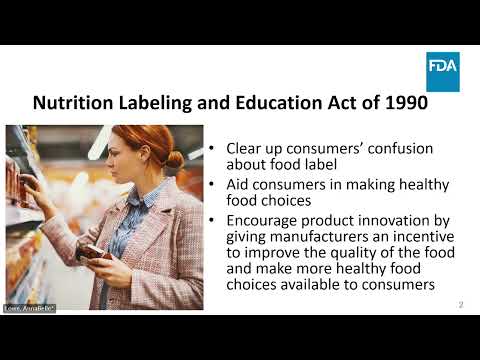
- Mandatory nutrients and history: The Nutrition Facts label traces to the Food, Drug, and Cosmetic Act with a major consumer'facing update under the Nutrition Labeling and Education Act (NLEA) of 1990; labels first appeared on packages in 1994 and were updated in 2006 and again in 2016 (the 2016 update added the added sugars line).
- Percent Daily Value (%DV): %DV shows how much a nutrient in one serving contributes to a daily diet (2,000 calories is the reference point). FDA uses general guidance that 5% DV or less per serving is "low" and 20% DV or more is "high," which helps consumers compare products.
- Nutrients to limit and to encourage: Nutrition labels list nutrients tied to chronic disease risk (saturated fat, trans fat, sodium, added sugars) that many consumers should limit and also list nutrients often underconsumed (dietary fiber, vitamin D, calcium, iron, potassium) that consumers may want more of.
- Ingredient list and comparisons: Ingredients are listed by common or usual name in descending order by weight; consumers can use both the ingredient list and the nutrition facts to compare products (for example, when %DV is not provided for a nutrient such as trans fat or total sugars).
- Practical examples: Crystal Rivers said the 2006 label change requiring fat declaration contributed to industry reformulation and that mandatory declarations have supported an estimated 80% reduction in trans fat consumption over time. She also noted that about 40% of sodium intake comes from prepared foods such as deli sandwiches, pizzas and soups, making comparisons across brands useful for consumers seeking lower'sodium options.
Resources: FDA maintains consumer'facing nutrition education materials, infographics and fact sheets on its website and the presenters encouraged attendees to consult those resources for tailored guidance.
"If you need more information about the Nutrition Facts label, that information is on our website," Rivers said.