Get Full Government Meeting Transcripts, Videos, & Alerts Forever!
Get email alerts on the Border Security topic
No spam. Unsubscribe anytime.
Senate Republican leader praises Border Patrol, says anti-weaponization fund is off the table as secure-borders push continues
Summary
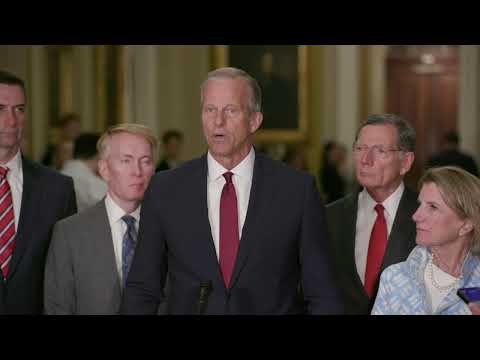
The Senate Republican leader lauded the Border Patrol’s recent performance and said an "anti-weaponization" fund is off the table after conversations with the Attorney General, while stressing that passage of major bills hinges on having 50 Senate votes.
Senate Republican leader told reporters that the Border Patrol marked its 102nd anniversary amid what he described as a major improvement in enforcement, and said Republicans will press the Secure Borders Act while seeking resources for ICE and Customs and Border Protection.
The leader said, "Last Thursday was the 102nd anniversary of the Border Patrol in this country," and argued that "what we inherited from the Biden administration was the most open border that we've ever seen." He added that Border Patrol had "completely cleaned that up," and, quoting statistics discussed at the briefing, said there had been "an entire year where there hadn't been a single illegal released into the country." Those assertions were presented as the leader's characterization of recent enforcement results.
The leader framed the coming week's agenda around border security, saying Republicans "intend to ensure that law enforcement both ICE and CBP have the resources they need to carry out the responsibilities that they are given by the American people." He contrasted that approach with what he called "Democrat policies" and said voters do not want to "defund the police."
On a separate matter raised by reporters, the leader said he had spoken with the Attorney General before the official's House testimony and said that testimony should provide "certainty" to lawmakers weighing a reconciliation bill. When asked whether Speaker Johnson's understanding that the anti-weaponization fund was off the table matched his own, the leader replied, "That is correct." The leader cautioned, however, that advancing major legislation depends on arithmetic in the Senate—"it's do we have the votes?"—and that party cohesion is necessary to reach 50 votes.
When asked about a reported acting-director nomination for the intelligence community, the leader said any permanent appointment must come through the Senate confirmation process and deferred detailed judgment to committee leaders. Senator Cotton, called on by the leader to speak to intelligence oversight, said he expects to implement reforms in the Intelligence Authorization Act and described returning the Office of the Director of National Intelligence to a coordinator role.
The leader also addressed the question of intra-party dynamics after recent primaries, reiterating that Senate work depends on building the votes to pass measures and expressing confidence that members will work together to present accomplishments ahead of the fall elections.
The briefing concluded with no announced votes or formal actions; leaders described priorities and political constraints facing the Senate as it considers border legislation and other business.