Get Full Government Meeting Transcripts, Videos, & Alerts Forever!
Get email alerts on the Zoning topic
No spam. Unsubscribe anytime.
Jackson council approves rezoning for 219 Pleasant Plains after residents protest
Summary
After extended public comment and debate about traffic and 'spot zoning,' the Jackson City Council approved on first reading an ordinance to rezone 219 Pleasant Plains Road from single-family residential to office district by a 6–3 vote on June 2, 2026.
The Jackson City Council approved on first reading a rezoning ordinance for 219 Pleasant Plains Road, a 1.14-acre parcel on the northwest quadrant of Mlen and Pleasant Plains, after residents raised objections about traffic, safety and the precedent it would set for future commercial development.
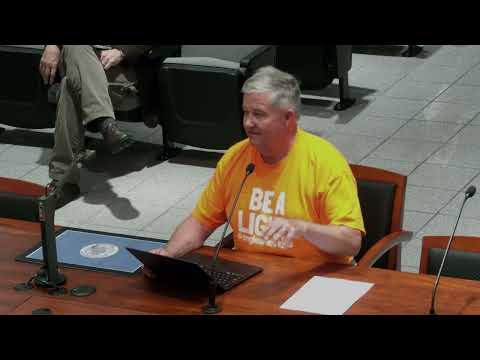
Residents filled the public-comment period to oppose the request. "I sent each one of you a survey ... 95% of the people of the roughly 400 that responded are against this rezoning," said Bob Alvi, a Stonehenge Drive resident, urging the council to reject the change. Several neighborhood leaders — including Steve Sperlin, president of the Cherry Hill Place HOA, and Larry Daniel, president of the Rights Mill Homeowners Association — also opposed commercial development at the corner and urged council members to uphold past votes that rejected similar proposals.
Planning staff and the property owner’s representative disputed the scale of expected traffic impacts. Planning Director Stan said the current request seeks O (office) zoning, which staff characterized as office-only, not commercial, and described how the request differs from prior attempts that sought broader commercial allowances. Stan said the city engaged its consulting traffic engineer, who concluded the "potential for significant traffic impacts from the project is negligible" and estimated roughly "20 to 30 entry and exit movements at each driveway in a peak hour." He added that full traffic studies are typically performed at permitting because they can be costly and may be unnecessary at rezoning when impacts are expected to be low.
Residents pushed back repeatedly on that point. "If you build another bank on the corner ... we already have serious traffic issues," said Bob Herring, president of a local association, citing narrow roads, potholes and safety concerns near schools and churches. Christina Young questioned whether the planning packet contained an actual traffic study and warned that approving a single lot for office use could constitute unlawful spot zoning and encourage further commercial encroachment into nearby residential parcels.
The developer’s representative, introduced as Shane Alexander, said the current request limits development to the corner acre and that the owner had no immediate plans to commercialize the remaining acreage, and even offered the corner land for potential public uses if desired. "We don't have any plans to do [more]; it'll stay residential," he said.
After discussion on traffic mitigation, the land-use plan context and assurances about the balance of surrounding acreage, the council voted 6–3 in favor of the rezoning on the ordinance’s consideration.
The ordinance passed on first reading; council members who said they supported the measure also asked staff to provide clearer details on planned road improvements before the next meeting.
What happens next: the vote recorded in the meeting was on the council floor during consideration; the transcript indicates the ordinance passed first reading 6–3. Any final permitting, site plan review, or required driveway-level traffic analysis will occur at the development-permit stage.