Get Full Government Meeting Transcripts, Videos, & Alerts Forever!
Get email alerts on the Education Infrastructure topic
No spam. Unsubscribe anytime.
Founder seeks conditional rezoning for 8.7-acre Allesium School site; neighbors raise traffic fears
Summary
Tori Thompson asked to build a phased, hybrid Allesium School on 8.7 acres behind a Duke Energy easement; staff recommended conditions (urban open space, elevations, vehicle-stacking plan) and neighbors warned the school's traffic could worsen existing backups on Babe Stillwell Road and Highway 73.
Tori Thompson, founder and chief executive of Allesium School of Innovation, asked the board for a conditional rezoning that would allow a micro-hybrid private school on an 8.7-acre site along Babe Stillwell Farm Road. Staff described the site as vacant, surrounded by single-family homes, and bisected by a 250-foot Duke Energy easement that forces buildings far back from the road frontage; staff said schools are allowed by right but the modification is required because of the setback and other site constraints.
Staff listed conditions that would need to be met for support: a larger, functional urban open space that fronts the buildings; additional elevation detail to confirm materials comply with the civic building type (which limits metal facades to 30%); a vehicle stacking plan to manage drop-off and pick-up; and clarifications to the phasing plan. Staff also noted tree-canopy preservation and specimen-tree-save commitments (staff recorded the applicant’s proposal to provide 30% canopy-tree save and 82% specimen-tree save) as positive elements.
Thompson described Allesium as a small hybrid program (students attend two days on campus and have remote days and field work on Fridays), said hours would be roughly 9:00 a.m.–2:40 p.m., and initially proposed a phased buildout that could ultimately serve up to about 150 students (with fewer students on campus at once because of the hybrid model). She emphasized outdoor learning, strong academic outcomes, and a family-focused approach.
Board members focused extensive questions on traffic, vehicle stacking and phasing: how many students would be on campus at peak, whether after‑school programs or large events were planned, and what stacking or scheduling strategies the school would use to avoid neighborhood backups. Thompson said staggered start times, carpooling, and flexible scheduling could mitigate issues and that the hybrid model intentionally reduces daily campus load. She agreed the applicant would provide a vehicle stacking plan and work on additional details requested by staff before the planning board step.
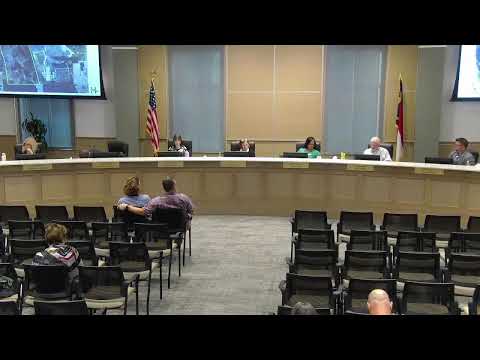
A nearby resident, Bonnie Logan, spoke in opposition during public comment, describing current severe backups on Highway 73 and Babe Stillwell Road and warning a 150-student school could further impair local traffic, create safety risks, and depress nearby property values. The board did not vote during the hearing; staff and the applicant will return with additional materials (vehicle stacking plan, updated urban open-space design, elevations, and final phasing details).
Next steps: staff recommended conditioning future approval on the requested documentation and design changes; the applicant was asked to consult with adjacent-school administrators about traffic mitigation and to provide stacking and phasing clarifications before the item advances to the planning board.