Get Full Government Meeting Transcripts, Videos, & Alerts Forever!
Get email alerts on the Jones Avenue Solar topic
No spam. Unsubscribe anytime.
Portsmouth advisers weigh Jones Avenue landfill solar but recommend rooftop, behind-the-meter projects first
Summary
City staff presented three options for a 1.7 MW landfill solar project and models showing the greatest financial upside requires qualifying for an investment tax credit. Committee members pressed staff on permitting, interconnection timing, and alternatives; staff recommended prioritizing rooftop and behind‑the‑meter sites as lower‑cost, lower‑permit options.
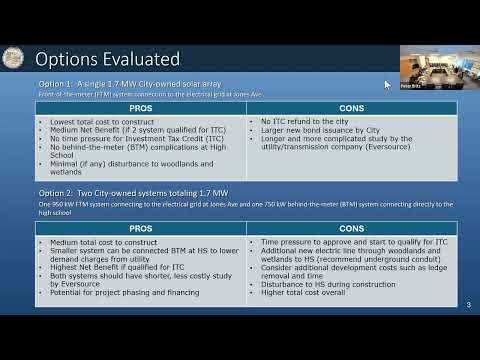
Christine Spurero of the Department of Public Works presented an Apex Analytics feasibility study for a proposed solar array near Jones Avenue landfill and described three development scenarios: a single 1.7 megawatt (MW) front‑of‑meter system, two smaller city‑owned systems (950 kW front‑of‑meter plus 750 kW behind‑the‑meter at the high school), and a developer-built power purchase agreement (PPA) option.
Apex modeled costs, net benefits and timelines and told the Portsmouth Energy Advisory Committee that anything over 1 MW triggers an Eversource affected‑system operator study that can take 9–11 months and would likely push the project past the December 2027 deadline for claiming the federal investment tax credit (ITC). "You do need that system up and running by 2027," Spurero said, noting the ITC window and that phasing the project into sub‑megawatt pieces was one way to retain eligibility.
The consultants said the two‑system option would deliver the highest net benefit if the ITC is captured and could shorten interconnection study time, but it would add permitting complexity and increase wetland and woodland impacts because the high‑school connection would require new electric lines through sensitive areas. The single 1.7 MW option had the lowest construction cost and would minimize disturbance to woodlands and wetlands but would likely forfeit the ITC and require a longer study.
Apex's financial models projected a break‑even point near 16 years for the split‑system option with ITC and about 20 years for the single system without ITC. The PPA option showed the lowest city benefit under the study's assumptions. "With the ITC option the two‑system has the largest net benefit," the consultant summarized during the presentation.
Committee members pressed staff and the consultants on operational and technical details. Ben asked whether the high school’s meters and pool loads could absorb the proposed behind‑the‑meter output; staff replied that meter configuration and load profiles need verification before concluding a 1.7 MW behind‑the‑meter deployment would be fully utilized. On equipment life, the presenters said the analysis used a 25‑year modeling horizon and noted inverters typically last about 10 years and panel degradation is modeled at 0.5% per year.
Environmental and landfill‑cap issues were a central concern. Staff warned that the landfill’s permit renewal and any reclassification could require geotechnical stability studies, stormwater and gas monitoring updates, and possible rework of the landfill cap. Committee members raised the likely need for a construction corridor through wetlands and ledge and asked for better estimates of buried‑line and mitigation costs; one attendee offered an order‑of‑magnitude guess of $300,000 for buried‑line work but presenters emphasized design‑level estimates are required.
After reviewing the analysis, city staff recommended exploring lower‑permit, behind‑the‑meter rooftop and municipal sites first — such as DPW roofs, the high school, and wastewater treatment plant opportunities — while retaining the landfill as a longer‑term possibility. Spurero said the city will provide the committee with the full slides and pro forma and follow up on specific technical questions, including the high school meter configuration and levelized cost estimates. The city will also prepare additional permitting and cost detail if the committee requests further study.
The committee closed the solar discussion by asking staff to circulate the materials and to scope follow‑up questions for council consideration; staff confirmed they would supply the requested documentation and would refine timelines and cost detail for the council and future deliberations.