Get Full Government Meeting Transcripts, Videos, & Alerts Forever!
Get email alerts on the Budget Outlook topic
No spam. Unsubscribe anytime.
Finance staff reports 2025 surplus driven by investment income; previews 2027 budget pressures
Summary
Staff told Madison’s finance committee that 2025 revenues finished about 4% above budget—primarily from investment income and Medicaid‑related ambulance payments—yielding a general fund near 30% of budget. Staff warned that 2027 faces salary, fuel and software cost pressures and outlined the budget calendar.
Finance staff presented the city’s 2025 year‑end results and an early look at the 2027 budget to the Madison Finance Committee on June 1.
Director Schmidiki reported that 2025 revenues finished roughly 4% above budget, driven mainly by higher investment income and a one‑time receipt of Medicaid‑related payments for ambulance services. Expenditures were about $4 million below budget, largely due to vacant positions and under‑spending in several departments. As a result, the city’s general fund balance stands near 30% of budget.
Staff cautioned that the favorable 2025 results do not eliminate structural pressures. The five‑year plan assumes using fund balance to close a projected gap over time, moving toward the city’s 15% minimum. Major cost drivers identified for 2027 include annualizing partial‑year personnel commitments (staff estimated about $11 million in salary/benefit increases), a projected $1.5 million increase in fleet fuel costs, and higher software and cloud licensing expenses. Staff also noted volatility in interest rates could produce a mark‑to‑market loss in 2026 if rates stay high.
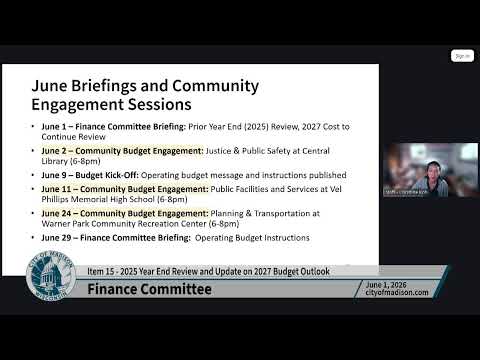
Budget Director Christine outlined the schedule for 2027: agency kickoff on June 9, submission of agency requests in mid‑July, a full finance committee projection on July 27, and adoption of budget adjustments in early August; the executive budget is expected in early October with subsequent committee briefings.
Committee members asked about mark‑to‑market exposure from rising interest rates and whether potential electricity or fuel cost increases would be covered; staff said the city is monitoring those risks and that some budget authority is constrained by the state expenditure restraint rules (ERIP), which affects the ability to add budget authority in 2026. No vote was required; the committee received the report and adjourned.