Get Full Government Meeting Transcripts, Videos, & Alerts Forever!
Get email alerts on the Virtual Fencing topic
No spam. Unsubscribe anytime.
CSU Extension presents virtual-fencing trial in Gunnison County; ranchers report faster gathers but stress training and costs
Summary
A CSU Extension intern and guests described local trials of virtual fencing in Gunnison County, saying the technology can speed cattle gathering and enable precision grazing but requires intensive training, periodic battery replacement and significant upfront tower costs.
Kaden Robbins, an intern with the CSU Extension office in Gunnison, opened a public presentation on virtual fencing technology and described two local trial towers that allow ranchers to test the systems without buying a base station.
Robbins said virtual fencing systems have three main parts: GPS collars that deliver sound and, if needed, shock stimuli; solar-powered base stations that link collars to the internet; and an online “herd manager” application where producers draw virtual boundaries and monitor animal movements. "My name is Kaden Robbins. I'm an intern with the CSU Extension office here in Gunnison," he said as he outlined the trial program.
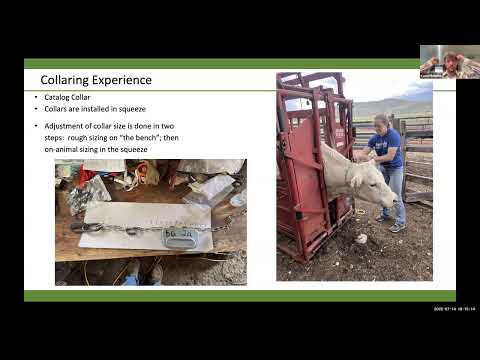
The presentation stressed trade-offs. Robbins and other presenters said collars can store multiple fences and operate autonomously when animals move out of tower range, but real-world battery life often falls short of vendor claims, particularly when animals frequently trigger stimuli. Robbins recommended careful collar cataloging and a 3–5 day training protocol that begins with a physical fence and moves gradually to virtual-only boundaries.
Rancher Darla Bramwell, a five-year user of the Vince system from Chromo, Colorado, described how training multiple generations of cattle reduced shock events and shortened fall gathering times. "We run between 300 and 350 mama cows," she said, adding that one ranch that once took weeks to gather cattle now completes that work in days. Bramwell also said she has expanded to five towers to cover her operations and advised new users to find local mentors when adopting the technology.
John (last name not specified), an agricultural economist who has worked with virtual-fence research for decades, framed the technology in broader rangeland and economic terms. He discussed experimental work that measured steer performance and enteric methane: in some conditions virtual fencing reduced methane by keeping cattle on actively growing plants; in drought years, however, the trials showed reduced animal performance. "Methane emissions is just lost energy, right? It's energy that came into the animal that didn't get turned into protein," he said while describing the research implications for efficiency and possible future market incentives.
On costs, Robbins summarized vendor pricing observed during his review: the vendor Vince advertises a roughly $10,000 base station (vendor-claimed coverage 5,000–10,000 acres); Halter cited a lower base fee and per-collar subscription; and Gallagher offers a purchase-plus-warranty model with modest monthly fees. Robbins cautioned that collar subscription fees and battery replacements can make ongoing costs significant for large herds.
Speakers emphasized where virtual fencing may be most useful: large ranches with high traditional-fence costs, public-land permit holders seeking to protect riparian zones, and operations targeting precision grazing or vegetation-restoration objectives. They also noted limitations: virtual fencing is a psychological rather than physical barrier, cannot reliably collar bulls with current designs, and requires pre-planned movement schedules to avoid operational failure.
During a short Q&A an attendee, Kathy, asked whether stocking density had increased for users. Bramwell said rotational grazing and higher stocking rates were possible in her experience, but Robbins said broader evidence is limited because most users have only recently adopted the tools.
The session closed with Robbins urging local producers to test systems through extension trials and vendor consultations, and to coordinate with neighbors or agencies to share tower costs or access funding. He offered contact information for follow-up and noted that improved collars are expected in coming years, which may change both costs and capabilities.