Get Full Government Meeting Transcripts, Videos, & Alerts Forever!
Get email alerts on the Cit Training topic
No spam. Unsubscribe anytime.
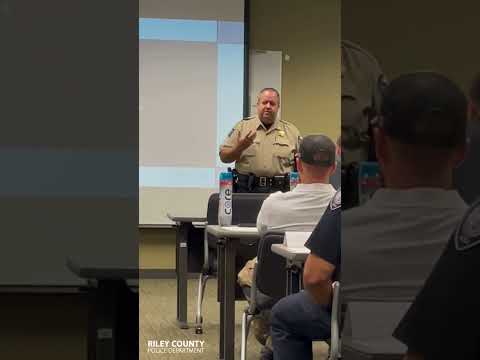
Undersheriff Doug Adams urges more crisis-intervention training for rural officers
Summary
Doug Adams, undersheriff of Pamy County, urged officers at a multi-day CIT training to prioritize de-escalation and networking, citing long rural response times and the program’s third year of participation; he thanked Riley County and KTC for providing the training free of charge.
Doug Adams, the undersheriff of Pamy County, urged officers at a crisis-intervention training to make the most of an intensive week of instruction, saying de-escalation skills are essential in rural law enforcement.
Adams said Pamy County is ‘‘very large’’—about 862 square miles—and that parts of the county can face long travel times to emergencies. ‘‘We—re not always the best option for dealing with people in Mental Health crisis but we—re often the only option especially in a rural area,’’ he said, arguing that additional training helps officers manage calls more safely and effectively.
The undersheriff emphasized the practical limits rural agencies face: officers sometimes need backup and may require 15 to 20 minutes to reach a call depending on weather and conditions. He described the training as a ‘‘very high quality’’ program and said this is the third year his county has been able to send officers. He thanked Riley County and KTC for making the training available without charge.
Adams also highlighted the role of multidisciplinary teams and local crisis-intervention (CIT) boards, saying they include law enforcement, mental-health professionals, hospital staff and court services and that coordination across those groups is critical. He encouraged attendees to network with instructors and local providers after class to learn what resources are available in their home communities.
Adams closed by urging active participation throughout the week and by thanking the organizers and participants for attending.