Get Full Government Meeting Transcripts, Videos, & Alerts Forever!
Get email alerts on the Economic Development Strategy topic
No spam. Unsubscribe anytime.
Alexandria convenes residents as consultants seek priorities ahead of May economic summit
Summary
City Manager Jim Perage and TIP Strategies consultants held a public session to gather resident input for an economic development strategy; discussions focused on talent, adaptive reuse of office space, entertainment and sports tourism, small-business support, and an implementation matrix to keep the plan active. The presummit survey and a virtual meeting precede a May 8 summit.
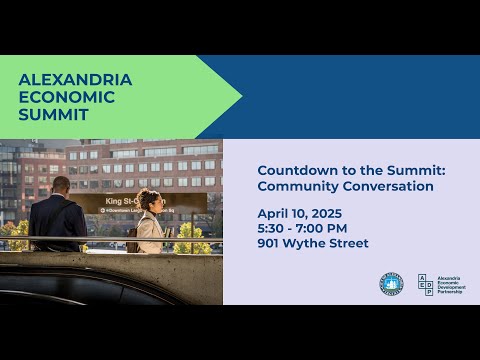
City Manager Jim Perage opened a public engagement session in Alexandria, saying the city has followed an economic development strategy for more than a decade but now faces shifting market conditions that require new approaches and greater community investment. "Economic development is about risk," Perage said, urging residents to help identify opportunities the city can pursue and to participate in a presummit survey and upcoming events.
Tracy McDonald, president of TIP Strategies, and her team framed the consultants' work as a mix of data analysis and resident engagement. McDonald described the city's engagement schedule, including a virtual meeting on April 21 and an economic development summit on May 8, and launched live polling to gather attendees' priorities. "We want to hear your perspectives," she said, asking residents to identify Alexandria's competitive advantages and gaps.
TIP Strategies' consultants summarized key national and local forces shaping investment. They cited site‑selection research that ranks talent, location and real estate conditions as top factors for employers and noted three national concerns flagged by site selectors: local political environment, federal funding uncertainty and workforce availability. Mishka Parkkins, a consultant with TIP Strategies, said the practice of economic development has broadened from real‑estate–focused attraction to people‑centered strategies that emphasize equitable growth, workforce development and place‑making.
Presenters stressed that the downtown office market has weakened since the pandemic and that higher vacancy rates create opportunities for adaptive reuse. Jennifer Todd, senior consultant, pointed to trends in construction and reuse, saying some communities are converting office space to residential or experience‑based uses. The consultants also noted a recent national uptick in data center investment, citing industry data showing roughly $35 billion in data center investment so far this year (presenters attributed that figure to recent national market data).
Residents and consultants discussed possible local priorities. Live polling put entertainment and retail near the top of residents' lists; attendees suggested youth and regional sports tournaments, immersive arts and enhanced meeting/convention capacity as ways to draw visitors and support local businesses. "Every time I have to drive an hour to go to a soccer tournament and come back home every night, I say, why can't we do more of that closer to home?" a resident said, urging sports‑tourism planning.
Community concerns surfaced repeatedly. Multiple attendees stressed housing affordability, displacement of long‑standing small businesses during redevelopment, and limited transit connections as constraints on growth. One participant asked for more concrete survey options to solicit specific suggestions rather than only aspirational responses; consultants said a follow‑up, feedback‑oriented survey and continued town‑hall reporting are planned.
On implementation, the consultants emphasized an "implementation matrix" that will pair recommended actions with lead organizations, supporting partners, timelines and reporting structures so the plan does not merely sit on a shelf. "We try to find what works within your existing structure," McDonald said, describing how the matrix can be reprioritized as economic conditions change.
Asked about regional competition, panelists agreed Alexandria should be benchmarked against nearby jurisdictions and should pursue complementary strengths rather than duplicating capabilities in neighboring localities. Presenters identified potential target sectors for Alexandria—advanced technologies (AI, cybersecurity), nonprofit and association headquarters, creative industries, tourism and healthcare—while underscoring the city's strengths in talent, proximity to Washington, D.C., waterfront amenities and high foot traffic.
Next steps are procedural: attendees were encouraged to complete the presummit survey (QR codes were posted), the consultant team will deliver assessment and benchmarking results to the city and partnership, and the May 8 summit will refine the strategic framework with an implementation focus. No formal decisions or votes were taken at the session.