Get Full Government Meeting Transcripts, Videos, & Alerts Forever!
Get email alerts on the Meeting Scheduling topic
No spam. Unsubscribe anytime.
Santa Clara governance committee delays adoption of special-meeting scheduling policy amid broader questions about adding regular meetings and remote attendance
Summary
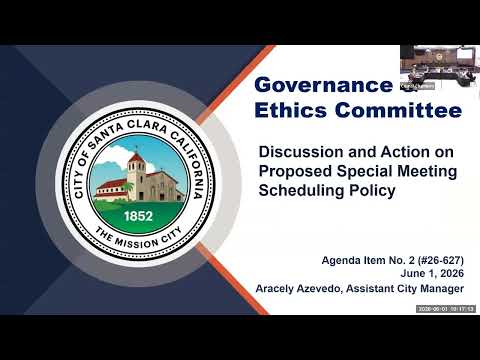
The Santa Clara Governance & Ethics Committee heard a staff proposal to standardize how the city schedules special meetings and to pre‑schedule two additional special meetings each month. Members raised concerns about remote participation limits, charter implications for unexcused absences, and whether some extra dates should instead be declared regular meetings. The committee voted to continue the item so staff can return with more analysis.
The Santa Clara Governance & Ethics Committee on June 1 heard a staff proposal to formalize the city’s process for scheduling special meetings, but deferred action after members asked staff and the city attorney to analyze how the changes would interact with state rules on remote participation and the city charter’s attendance rules.
City Manager Javon told the committee the draft policy documents a staff process already in use: the city manager’s office will identify three Brown Act–compliant candidate dates, the city clerk will poll council members with a 48‑hour response window, staff will keep an internal availability summary, and the manager will pick the date with the greatest availability (tie‑breaker: earliest date). He said the city has held “40 plus” council meetings in recent years and staff believes scheduling two additional special meetings each month would add consistency and predictability.
Why it matters: Members warned the operational fix could have unintended legal and practical consequences. Member Park and others said converting extra dates into regular meetings could change how many "for‑cause" remote participations a member may use under state rules (SB77/AB49), and could also alter how quickly a pattern of unexcused absences — currently described in the charter as "five consecutive regular meetings" — might trigger vacancy rules. “If we add more regular meetings, we might accidentally make it easier for someone to hit five consecutive unexcused absences,” a committee member said, pressing staff to model the effect.
The committee also debated whether special meetings scheduled for routine council business should include public‑presentation time. Staff said special meetings can be held as study sessions or business meetings, and the draft can be revised to make public presentation availability explicit. The city attorney cautioned about Brown Act pitfalls when council members coordinate to initiate a meeting and said the revised scheduling form and process have been rewritten to avoid inadvertent serial communications.
Public commenter Chris Stampus, of Santa Clara, urged clearer rules for how members of the public can request items be placed on future agendas and asked the committee to clarify whether the downtown community task force may agendaize items for council.
Outcome and next steps: After discussion, Member Park moved to continue the item so staff and the city attorney can: (1) confirm how SB77/AB49 remote‑participation limits apply to special meetings, (2) catalogue which council actions require regular‑meeting status, and (3) analyze charter implications for attendance and any needed policy calibration. The motion passed unanimously. Staff was directed to return with answers and with options for whether to add additional regular meetings to the calendar or to keep the proposed process for special meetings.
Votes at a glance: the committee approved the consent calendar (minutes for April 13 and May 21) with a correction, and later voted unanimously to continue the scheduling policy for further study.
The committee deferred a separate agenda item (Item 3) and will take up the scheduling policy again after staff provides the requested legal and operational analysis.