Get Full Government Meeting Transcripts, Videos, & Alerts Forever!
Get email alerts on the Energy Transmission topic
No spam. Unsubscribe anytime.
Power on Midwest officials outline 765 kV transmission plan as corridor brushes Waseca County
Summary
Project representatives told Waseca County commissioners that the Power on Midwest 765‑kilovolt transmission proposal is intended to meet roughly 25% regional electricity growth, that one broad corridor "touches the bottom edge of Waseca County," and that open houses and Minnesota PUC permitting are next steps.
Representatives for the Power on Midwest proposal told the Waseca County Board that regional electricity demand could rise about "25% growth over the next couple of decades," and that a single 765‑kilovolt (kV) transmission circuit is more efficient for carrying large amounts of power over long distances. The presenters said the project is one element of a broader MISO‑coordinated plan to improve Upper Midwest reliability and to carry energy from multiple future generation sources.
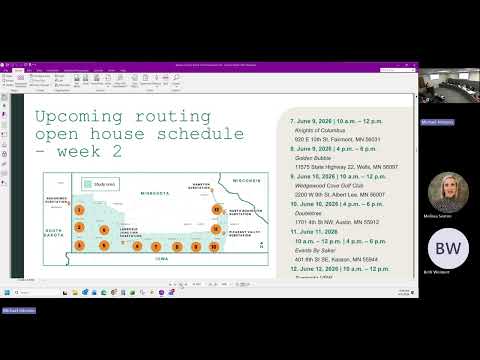
Why it matters: county residents near the proposed corridors will have opportunities to comment on route alternatives during a series of open houses and through the Minnesota Public Utilities Commission (MPUC) permitting process. The presenters said the Far North corridor as currently drawn "touches the bottom edge of Waseca County," which is why staff arranged the briefing and why nearby open houses were scheduled.
What presenters said: the briefing described the technical rationale for 765 kV lines — "one of these lines can carry about as much power as 6 345 kV single circuit lines" — and showed the project would use lattice towers in many places to support multiple conductors. Presenters said the project has filed a certificate of need application with the Minnesota Public Utilities Commission and that route‑permit work and additional public scoping will follow; the MPUC held 11 public information meetings in April and hearings were expected later in the year.
Local impacts and timeline: presenters described typical easement practice (a one‑time payment to landowners for a roughly 50‑foot easement, with owners retaining surface use except for the structure footprint) and said the project's first approach is negotiation; eminent‑domain statutes exist but are considered a last resort. They estimated major construction would not begin until the early‑to‑mid‑2030s, with regulatory filings, route narrowing and further open houses during 2027–2028 and continuing public engagement in the interim.
Next steps: project staff encouraged residents to review corridor maps on the project's website, attend the posted open houses and file comments; they said they will return with updated information after the next round of public meetings.
Representative quote: "25% growth over the next couple of decades," the presenter said when opening the briefing, framing the project as a response to rising demand.