Get Full Government Meeting Transcripts, Videos, & Alerts Forever!
Get email alerts on the Land Use Campgrounds topic
No spam. Unsubscribe anytime.
Pickens County Council advances revised campground ordinance with key drafting placeholders
Summary
Council approved changes to Section 302 (campgrounds) as a second reading, agreeing on a campground-only title, a working five-campsites-per-acre density, a 690-square-foot minimum site, and a placeholder 135-day consecutive-stay limit while deferring enforcement details to permitting and code enforcement.
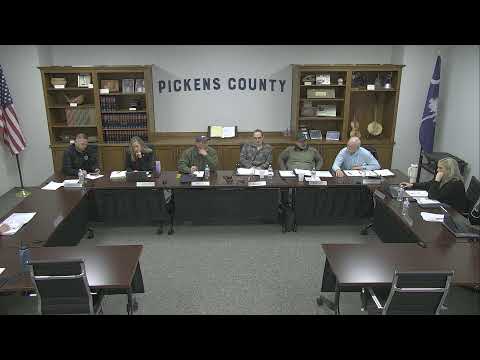
The Pickens County Council on March 16 advanced revisions to Section 302 — the county’s campground ordinance — on a second-reading motion, adopting a set of drafting choices and placeholders while directing staff to tighten enforcement language before final adoption.
The council agreed to use the single title "campground" rather than separating "RV parks" and "campgrounds," standardize terminology to "campsite" where appropriate, and adopt the Planning Commission’s wording for several technical sections, the chair said. Council settled on five campsites per acre as the working density cap, replacing the Planning Commission’s proposed six-per-acre figure and the chair’s earlier preference for four.
Destiny (Committee member) proposed adding an explanatory purpose clause to justify the five-to-10-acre size limit, arguing it would help the county defend the rule in court. "The acreage limitation is intended to ensure compatibility with surrounding rural land uses, manage traffic and infrastructure impacts and maintain the recreational character of campground developments," Destiny said; council accepted adding that rationale to the ordinance language.
The council also debated allowable camping structures. Members agreed that park-model or site-built cabins should be permitted with conditions, but that cabins should not be allowed as permanent residences. Council discussed draft language to prevent storage buildings being repurposed as cabins and to require cabins meet park-model or site-built standards.
On occupancy limits, Planning Commission had proposed reducing maximum stays from 180 to 90 days; staff warned enforcement challenges. Allison (staff member) said the county lacks the manpower for continuous monitoring but supported the rule in principle. Council compromised on a placeholder of 135 consecutive days pending clearer enforcement language. The council directed that a campsite management plan be filed with the development permit (not at the land-use stage) and that code enforcement be authorized to conduct periodic inspections; penalties would escalate from warnings to fines and, for repeat violations, revocation of permits or licenses.
Minimum-site-area and setback questions were also resolved in the draft: council agreed to revert to a previously used 890-square-foot baseline conceptually but left the working numeric minimum at 690 in the current draft with instructions to draft a short chart or clearer table to distinguish tent, RV and cabin site sizing. Setback requirements were confirmed at 100 feet from property lines, and for campgrounds with more than four campsites a storm shelter provision remains in place.
After the read-through and edits, the chair moved to accept the changes and advance Section 302 as a second reading. The motion passed by voice vote; the chair recorded the tally as 5–1 in favor.
Council members instructed staff to return with tightened drafting on enforcement, cross-references to UDSO/moratorium language for RVs, clarified measurement language for density calculations and a finalized management-plan submission location ahead of the third reading and public hearing.