Get Full Government Meeting Transcripts, Videos, & Alerts Forever!
Get email alerts on the Ambulance Services topic
No spam. Unsubscribe anytime.
Selectboard asks subcommittee to study fire chief's proposal to take on Fremont's ambulance service
Summary
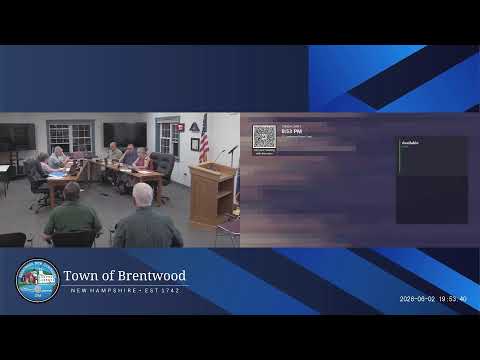
After a lengthy presentation and debate about projected costs and billing assumptions, the Brentwood selectboard voted to form a public-safety subcommittee to study a proposal by the fire chief that Brentwood provide Fremont's 911 ambulance coverage under a contract.
Brentwood's fire chief outlined an exploratory plan for the town to provide emergency-medical-service coverage to neighboring Fremont under a paid contract, and the selectboard voted to form a public-safety subcommittee to gather data and evaluate the idea.
Chief Olsson told the board he had discussed terms with Fremont officials and had run conservative estimates of revenues and costs. "So, we ran those numbers and then I came up with the $90,000 for the contract," he said, explaining the figure would supplement ambulance-billing revenue and could fund a third staffed position in Brentwood without using general-tax dollars if the payments and cost recovery were routed into a revolving ambulance account. He also described startup and operating assumptions, including his estimate that Fremont averages roughly 410 ambulance calls a year and that Brentwood's average revenue recovered per call (based on recent billing) was about $613.50.
Selectboard members pressed the chief for more detail on the assumptions behind those figures, the incremental cost to Brentwood (including wear and tear on vehicles and added staffing), and legal or contract safeguards that would be needed. Budget committee chair Jim Her urged caution and recommended routing the matter to the town's newly created public-safety strategic-planning team for a datadriven review before any municipal commitments. "Taking on a neighboring town's entire 911 EMS load is a major structural shift," he said, arguing the subcommittee should model 10-year fiscal impacts and concurrency risks.
Faced with competing views about timing and local capacity, the board voted to create a formal subcommittee to work with the chief, collect operational and financial data, review contract language and escalation clauses, and return recommendations to the selectboard. The transcript records the motion carried by majority vote (the board recorded the decision as "three to two" in the meeting transcript). The motion directs the chief to provide supporting spreadsheets, billing analysis and contract drafts to the subcommittee for review.
What happens next: the subcommittee will gather call volumes, billing and cost-recovery data, contract language and contingency clauses and report back to the selectboard. The transcript shows several members requested that the chief provide a spreadsheet of his analysis and that legal review be incorporated before any contract is finalized.