Get Full Government Meeting Transcripts, Videos, & Alerts Forever!
Get email alerts on the Municipal Budget topic
No spam. Unsubscribe anytime.
Waxhaw holds public hearing on $26.99 million proposed budget; manager recommends no tax-rate increase
Summary
At a June 2 public hearing, Waxhaw’s town manager presented a balanced $26.99 million FY2026–27 budget that maintains the tax rate at 29¢ per $100 valuation, outlines $5.97M in CIP appropriations from reserves, and identifies roughly $511,000 in operational reductions to limit use of fund balance.
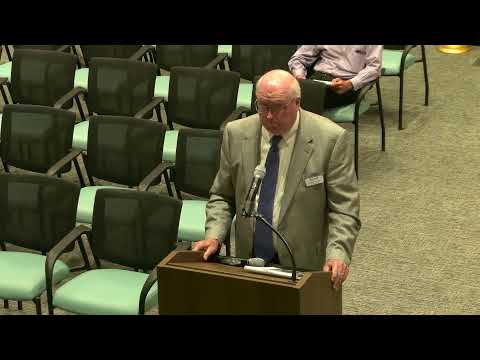
Waxhaw’s Board of Commissioners opened a public hearing on June 2, 2026 at town hall on the town’s proposed fiscal year 2026–27 budget. Town Manager Scott Dadson presented a balanced budget totaling $26.99 million and said he was not recommending a tax‑rate increase, leaving the rate at 29 cents per $100 valuation.
“The budget presented to you folks is 26.99 million and that is balanced between revenues and expenditures,” Dadson said during his presentation, adding, “I am not recommending a tax rate increase.” He said the proposed budget represents a 1.75% rise in total costs and revenues from the prior year.
Dadson told commissioners that property and vehicle taxes are the largest revenue source at about $15.32 million, with additional funding coming from Union County sales and use tax distributions, franchise tax, fees and other state shared revenues. He described major departmental spending as led by the police department ($6.36 million), parks and recreation ($2.6 million) and sanitation ($2.58 million).
To address board priorities on infrastructure, growth management and long‑term fiscal resilience, staff proposed a capital program funded from reserves. Dadson said the board previously adopted a five‑year capital improvement plan covering 49 projects valued at approximately $13.3 million, and that $5,972,749 would be appropriated from the town’s CIP reserves for FY27 projects rather than from new recurring revenue.
Highlighted projects in the presentation included a Pine Oak/Broom intersection signal, Kensington improvements (supported in part by outside grant funding), Helms Road right‑of‑way work, Old Providence intersection improvements and a Millbridge signal near the South Carolina line.
The manager identified several outside cost pressures that drove budget increases: a residential waste contract escalator that accounts for roughly $418,000 of additional cost, higher fuel and vehicle maintenance expenses, and increased street‑lighting costs (noted at about $310,000, up $55,000). He flagged a current sales and use tax shortfall as a concern and said staff budgeted conservatively for next year with no assumed growth.
On staffing, the budget maintains 110 full‑time positions and the equivalent of 15 part‑time roles; it includes four new patrol officers to be phased in at midyear as part of a three‑year staffing plan. Compensation changes proposed in the budget include a 2.5% cost‑of‑living adjustment and a 2% merit pool.
The board asked staff to identify operational savings; Dadson said staff exceeded the 5% target they were asked to find and identified about a 7% reduction in operational costs—roughly $511,000—through department‑level cuts, travel and training reductions and other adjustments. He also said the police department identified about $91,000 in federal forfeiture/empoundment funds that can only be used for law‑enforcement purposes and that some operating costs were shifted accordingly.
“Those reductions would allow less money to be drawn down from fund balance,” Dadson said, explaining that with the staff reductions and if the tax rate remains at 29 cents the net draw from unassigned fund balance would be about $488,570 (the presentation also referenced an initial $1 million proposed draw before reductions).
Commissioners asked about the town’s cash and reserve position. Dadson stated the unassigned fund balance was “around $29 million,” noted additional reserved funds for assigned projects, and said total cash as of the end of April was roughly $46 million. He said the board typically targets a reserve level around 40% (about four months of operating expenses) and that staff had set aside roughly $250,000 for capital reserves and recommended pay‑as‑you‑go capital of about $500,000.
No members of the public signed up to speak during the hearing. A clerk verified that the hearing notice was published in accordance with North Carolina General Statute 159‑12 and that the proposed budget had been available for inspection on the town website and in the clerk’s office since May 21, 2026.
The public hearing was closed by motion and voice vote. The board will have the opportunity to consider adopting the operating budget and a capital improvement ordinance at its regular meeting on June 9, 2026.