Get Full Government Meeting Transcripts, Videos, & Alerts Forever!
Get email alerts on the Fimp Contract3 Overview topic
No spam. Unsubscribe anytime.
Southampton holds public hearing on FIMP Contract 3 beach‑restoration plan and proposed easements
Summary
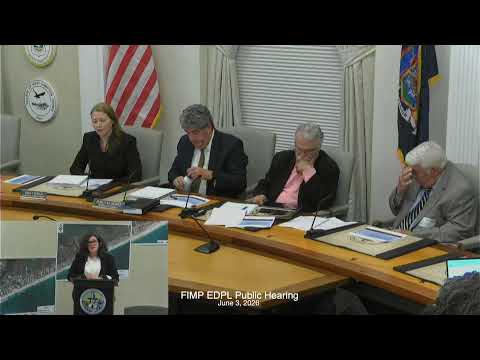
The Town of Southampton on June 3 held an Article 2 public hearing under New York's eminent domain law to present the Fire Island Inlet to Montauk Point (FIMP) Contract 3 beach‑restoration plan, describe the proposed perpetual storm‑damage reduction easements over roughly 98 private parcels, and accept public comment through July 3, 2026.
Southampton — The Town of Southampton presented plans and evidence on June 3 for the Fire Island Inlet to Montauk Point (FIMP) Contract 3 beach‑restoration project and opened an Article 2 eminent‑domain hearing to receive public comment on proposed perpetual beach storm‑damage reduction easements over affected private properties.
Assistant town attorney Kelly Doyle said the hearing was held pursuant to Section 203 of the New York Eminent Domain Procedure Law and that the record will remain open for written comments through July 3, 2026; the town will have 90 days after the close of the record to issue its determination and findings.
Why it matters: Project proponents say the multi‑agency FIMP program is designed to reduce barrier‑island breaching and overwash that can increase bay‑side flooding, protect mainland infrastructure and homes, and preserve habitat. The town and project partners describe beach nourishment, occasional dune construction and sand bypassing at Shinnecock Inlet as the core engineering approach; the plan includes a 30‑year sea‑level rise planning horizon and an estimated initial construction cost of about $76 million.
What officials said: Aram Tertunian, a coastal geologist with First Coastal, described the Contract 3 reach as roughly four miles covering portions of the village of Quag, East Quag and Hampton Bays. He said construction would create an engineered beach berm (about 90 feet wide in places) and dunes up to about 13 feet, with sand dredged from an offshore borrow area and pumped ashore. Modeling and monitoring indicate renourishment will likely be needed roughly every four years, subject to condition‑based adaptive management.
Aaron Nesmouth of the U.S. Army Corps of Engineers said the Corps is prepared to assist communities with coastal resiliency projects. A representative of the New York State Department of Environmental Conservation said the DEC is the project's non‑federal sponsor and noted the state budget recently included funding to cover 30 years of renourishment for the FIMP project. Robert Truhold, mayor of the village of Quag, said the village supports the project and offered help to answer residents' questions.
Environmental and technical points: Project documents entered into the record include a final environmental impact statement, Corps reports and partnership agreements. Presenters said the borrow sand was tested and matches beach grain size, which limits long‑term water‑quality impacts; the borrow cuts are shallow (about 7–10 feet) and short‑term turbidity is anticipated. Presenters also said widening the beach and creating dunes can reduce the likelihood of bay‑side wetland loss from overwash.
Administrative next steps: The town recorded and transcribed the hearing, placed exhibits in the public record, and invited written submissions. The public comment period is open through July 3, 2026; the town will review comments and then issue a determination within 90 days of the close of the record.
The hearing concluded with an invitation for affected property owners to contact the town attorney for maps and to review the record at Town Hall.