Get Full Government Meeting Transcripts, Videos, & Alerts Forever!
Get email alerts on the Immigration Enforcement topic
No spam. Unsubscribe anytime.
McCandless council adopts resolution limiting voluntary local assistance in noncriminal federal immigration enforcement after heated public comment
Summary
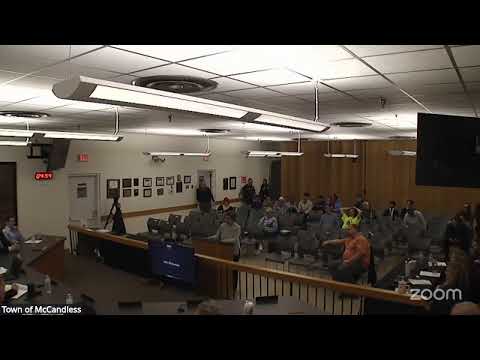
After more than two hours of public testimony from dozens of residents and legal advisers, the McCandless Town Council approved Resolution 20263, which formalizes a policy restricting voluntary local assistance in noncriminal federal immigration enforcement while preserving cooperation for criminal matters.
The McCandless Town Council on Feb. 23 adopted Resolution 20263, a measure formalizing limits on voluntary local cooperation with federal civil immigration enforcement.
The measure, introduced as the original “version A,” passed after an extended public-comment period in which residents presented sharply divided views about safety, civil liberties and the town’s role in national immigration enforcement. Council members framed the vote as an attempt to clarify existing local practice while protecting civil liberties and reducing operational confusion for local officers.
Supporters argued the resolution would protect residents’ access to emergency services and reduce fear in immigrant families. “We need to remember that when you call 911, the police are going to show up,” one resident said, urging the council to avoid chilling community cooperation with local police. Another resident addressing the council said the draft ‘‘codifies existing policy’’ and would create clarity for police and school administrators.
Opponents warned the draft could hinder interagency cooperation and pose public-safety or legal risks. ‘‘This resolution came out of nowhere,’’ resident Matt Shipley told the council, adding that the measure was ‘‘a resolution in search of a problem’’ and saying it could ‘‘divide us as a town.’’ An unnamed legal presenter addressed the council at length, arguing the draft misstated Pennsylvania and federal law, could create operational confusion for officers and in some provisions went beyond existing practice.
Council members repeatedly sought to distinguish criminal from civil immigration matters. Several councillors and speakers emphasized that the measure does not stop cooperation when a criminal investigation or judicial warrant is involved. The town’s solicitor and police chief (referenced repeatedly in public remarks) were cited by supporters as having reviewed and explained the draft language to the council, with advocates saying key legal risks had been vetted.
Before the vote, a number of residents shared personal stories about interactions with law enforcement, fears about family members being detained, and examples they said supported their positions on either side. Junior town-council representatives also spoke about the resolution’s potential impact on young people’s trust in public institutions.
After discussion, council members moved and seconded the original version (A) of Resolution 20263. The council completed a roll-call vote and approved the resolution as presented. The council announced the result at the meeting and then moved on to remaining agenda items, including routine planning and finance reports.
What’s next: Council members said the resolution is intended as a local policy statement; they did not describe an immediate change to daily police procedures for criminal matters. Officials indicated the town will provide guidance to staff and police about how the resolution will apply in practice and that legal counsel remains available to clarify implementation questions.
The vote follows weeks of draft revisions and public discussion; several speakers criticized the timing or transparency of multiple drafts. The council’s packet and meeting minutes contain the text of the drafts and will remain part of the public record.
For the record: the council moved to approve Resolution 20263 (original version A) during the Feb. 23 meeting. The meeting included extended public comment and a roll-call vote by council members; the council announced the measure as adopted at the meeting.