Get Full Government Meeting Transcripts, Videos, & Alerts Forever!
Get email alerts on the Reemployment After Retirement topic
No spam. Unsubscribe anytime.
Briefings outline reemployment-after-retirement rules; waiver restored and police rehired health coverage changed
Summary
TRS and KPPPA staff reviewed state law on retirees returning to work, described break-in-service rules, day and earnings limits, the recent reinstatement of TRSwaiver program, and House Bill 213which allows rehired officers to receive employer-offered health insurance starting Aug. 1, 2026.
Officials from the Teachers Retirement System and KPPPA briefed the Public Pension Oversight Board on reemployment rules for retirees, recent legislative changes and compliance risks for both school and public-safety retirees.
Bo Barnes, deputy executive secretary and general counsel for TRS, walked members through KRS 161.605 and the program structure that governs how retired teachers may return to work for TRS-participating employers. Barnes said the rules serve three goals: help districts fill staffing needs, require actuarially sound contributions when retirees return, and maintain federal tax qualification for the plan.
Barnes explained statutory break-in-service and participation rules: standard part-time reemployment generally requires a three-month break; full-time return to work requires a three-month break if switching employers and a 12-month break when returning full-time to the same employer. He described the daily wage threshold (DWT) that limits how much a retiree can earn when returning: 75% of a final contract salary for those with 30+ years of service and 65% for those with less than 30 years, with a statutory floor raised from $170 to $200 a day in 2025 legislation.
Barnes also summarized the waiver program, recently reinstated and effective July 15 (per 2025 legislation), which allows retirees to temporarily suspend their retirement allowance and return to work; reretirement calculations may be limited so benefits do not increase more than 10% for each full year worked under the waiver. He said TRS currently shows about 5,382 retirees in return-to-work positions (roughly 7% of active members), with over 94% working part-time or as substitutes, only 4% of available standard full-time slots used, 5,697 critical-shortage positions statewide with only 71 filled, and 52 retirees still in the grandfathered waiver program.
Compliance focus and employer discretion: Barnes emphasized that pre-arranged rehire agreements are prohibited because they risk disqualifying the system under Internal Revenue Code rules. He also noted employers decide whether to enroll reemployed retirees in part-time or full-time categories; part-time statutory limits (6,900s of a contract year) reflect the program definition, not an absolute prohibition on an individual working many days if the employer wishes to hire them full-time.
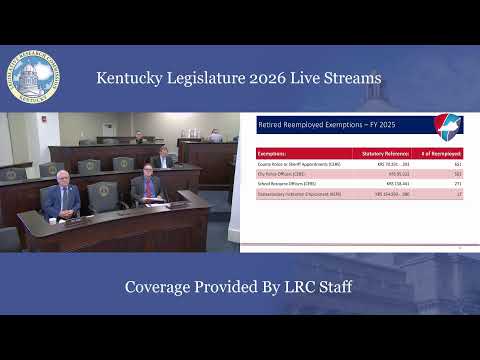
KPPPA summary: Ryan Barrow and Aaron Sarat explained KPPPA-administered plans have similar compliance obligations. Sarat said for members retiring on or after Jan. 1, 2024, KPPPA requires a one-calendar-month break in service; reemployment within 12 months requires submission of forms for certification. Non-compliance (for example, a pre-arranged agreement or failure to observe the break) can void the retirement, require repayment of allowances and health-premium reimbursements, and in many cases disallow a second retirement account.
Legislative update: Sarat highlighted House Bill 213 changes affecting rehired police officers: effective Aug. 1, 2026, cities, sheriffdepartments and postsecondary institutions may offer health insurance to rehired officers if the governing body authorizes it. The bill also standardizes the base year cities use to determine permissible exempt positions.
Data and fiscal notes: KPPPA reported that, across systems, about 5,000 retirees were reemployed in FY25, and KPPPA collected just over $39 million in employer contributions and about $22 million in health insurance reimbursements for those reemployment arrangements in fiscal year 2025.
Members raised operational questions about substitute-day limits, geographic clustering of critical-shortage hires, and the economics of the DWT; presenters said employer hiring practices and local staffing needs largely determine utilization. The board did not take immediate action beyond asking staff to supply additional data as requested.
Next steps: TRS and KPPPA staff offered to provide more granular cost and utilization data if members want to consider program changes or targeted outreach.