Get Full Government Meeting Transcripts, Videos, & Alerts Forever!
Get email alerts on the Budget topic
No spam. Unsubscribe anytime.
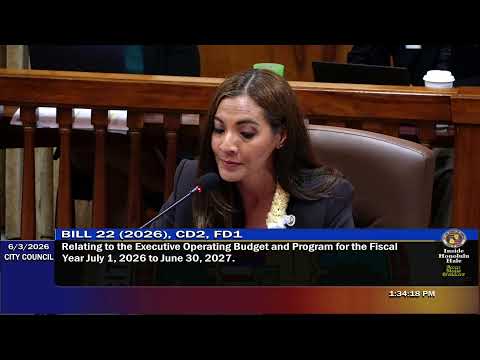
Honolulu City Council adopts amended FY‑27 operating budget after heated debate over O.E.R. cuts
Summary
The Honolulu City Council voted 6–3 to adopt an amended executive operating budget (Bill 22, CD2 FD‑1). The floor fight centered on proposed cuts to the Office of Economic Revitalization and reductions across departments; supporters said the FD‑1 increases accountability and reduces lapses while opponents warned of program and recovery impacts.
The Honolulu City Council adopted an amended executive operating budget (Bill 22, CD2 FD‑1) after lengthy debate and department testimony, passing the measure 6–3 on third reading.
Councilmember Aaron Okimoto moved the motion to pass Bill 22 on third reading; the Council then heard extended remarks from Mayor Rick Blangiardi and department leaders. The mayor urged restoration of funding for the Office of Economic Revitalization (O.E.R.), highlighting the city’s pandemic response and the office’s role in distributing federal funds. “We provided over $325 million to more than 24,000 families during the pandemic,” the mayor said in his remarks, arguing that O.E.R. built capacity the city lacked previously.
Budget Director Andy Kawano gave a technical overview of the FD‑1 and said the council’s amendments did not materially change the total budget but did shift priorities across departments. O.E.R. Director Amy Asselbaye told the Council that cuts would jeopardize four core program areas—small business support, local agriculture, workforce development and the city’s economic planning capacity—and cited more than $408 million in external funding O.E.R. managed. “Restoration of O.E.R. funding will ensure the city’s investment and economic development deliver measurable outcomes for residents and businesses,” Asselbaye said.
The City Auditor summarized a recent audit of O.E.R., noting the office had not met several charter responsibilities and recommended an annual performance report and a five‑year strategic plan. Troy Shimasaki, City Auditor, told the Council the audit’s recommendations were intended to strengthen accountability and transparency.
Several department heads and the interim police chief warned that reductions and provisos could create unfunded mandates and reduce operational flexibility. Interim HPD Chief Rade Vanic noted there were several hundred funded but vacant sworn positions and argued that removing salary appropriations while adding requirements would harm readiness. DPP Director Dawn Takeuchi Apuna warned that a roughly $2 million reduction in DPP current expenses could reduce preconstruction grants and slow permitting improvements.
Public testimony factored heavily in the debate: dozens of witnesses urged restoration of O.E.R. funding and pressed the Council to prioritize urgent recovery grants for farmers and small businesses affected by the March Kona Low storms. Farmers and nonprofit leaders described crop loss, infrastructure damage and an ongoing need for timely, low‑barrier assistance.
After members spoke on both sides of the question, the Council took a roll call. The final vote tally recorded six ayes and three nos; supporters argued the FD‑1 improves fiscal discipline by reducing historically large lapses and targeting funds to pressing priorities, while opponents said cuts to program staff and current expenses would reduce the city’s capacity to deploy recovery grants and to deliver critically needed services.
The adopted FD‑1 includes targeted restorations and provisos across several departments; the Council directed Administration to work with departments on implementation details and to provide further reporting as requested. The Council recessed for lunch after the vote; the adopted budget will proceed to the remaining procedural steps required for finalization.