Get Full Government Meeting Transcripts, Videos, & Alerts Forever!
Get email alerts on the Audit Ccrsd topic
No spam. Unsubscribe anytime.
External auditors issue unmodified opinion for CCRSD, flag GASB 101 impact
Summary
Auditors presented an unmodified opinion on the Concord‑Carlisle Regional School District’s FY25 financial statements, reported no material weaknesses in internal control, and highlighted a $1.7 million liability increase from GASB 101 implementation and pension/OPEB funding levels.
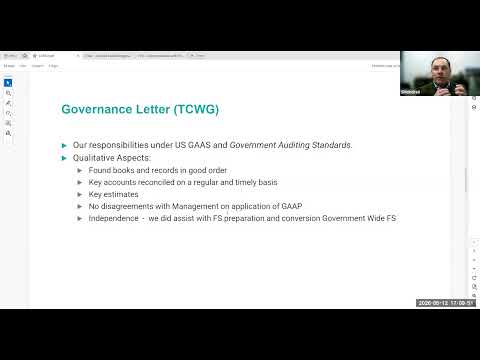
Scott McIntyre, the presenting auditor, told the Finance Audit Advisory Committee on May 12 that his firm issued unmodified opinions on Concord‑Carlisle Regional School District’s (CCRSD) June 30, 2025 financial statements and did not identify any material weaknesses in internal control. He summarized the audit reports — the opinion on the financial statements, the internal control communication required by government auditing standards, and a governance letter to those charged with governance.
The auditor noted the district’s unassigned general fund balance was about $1.9 million at June 30, 2025, a decline of roughly $100,000 from the prior year, and explained that about $700,000 of fund balance was used (approximately $300,000 for operations and $400,000 to the capital stabilization fund). He said the district implemented GASB Statement No. 101 on compensated absences in FY25, which expanded the defined liability for compensated absences and increased the district’s liability by roughly $1.7 million.
McIntyre described the long‑term perspective of the statements as focused primarily on pension and other postemployment benefits (OPEB). He said the district’s pension plan is “just under 92% funded” and the OPEB plan is about 62% funded, and reported actuaries project OPEB to be fully funded by 2043. He also told the committee the audit firm provided assistance compiling government‑wide financial statements and disclosed that as a required matter of independence.
Committee members asked technical questions about materiality thresholds and specific line items. McIntyre described his general materiality approach as roughly 2–3% of revenues or expenditures depending on the fund and noted that, from a government‑wide perspective, materiality is often evaluated against total assets for capital‑intensive items. Members also questioned a roughly $4 million line for programs with other districts; staff explained that represented out‑of‑district tuition and had increased by about $1 million in FY25 and was carried into the FY26 budget.
The presentation closed with staff and members agreeing to draft a letter to the school committee summarizing the audit and to circulate the PowerPoint and reports to committee members prior to the next meeting. The committee asked that the audit letter be prepared sooner than last year.