Get Full Government Meeting Transcripts, Videos, & Alerts Forever!
Get email alerts on the Subdivision Regulations topic
No spam. Unsubscribe anytime.
Blanco County court authorizes outside litigation counsel, opens workshop on subdivision rules focusing on water studies, bond sign-off and septic permits
Summary
On Jan. 28, 2025 the Blanco County Commissioners Court approved a motion to authorize the County Judge to contract outside litigation counsel and then held a workshop on proposed subdivision regulations that centered on water-availability requirements, exceptions (6- and 10-acre thresholds and veterans exemptions), a proposed bond sign-off checklist and septic-permit handling for unplatted development.
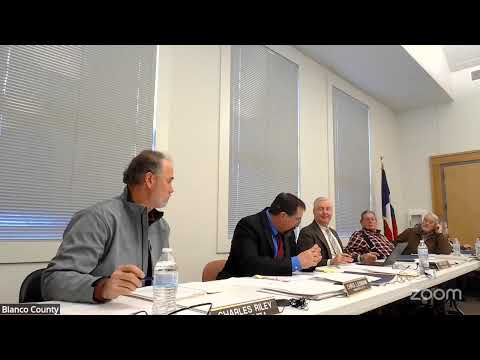
The Blanco County Commissioners Court reconvened Jan. 28, 2025, approved a motion authorizing the County Judge to contract with outside litigation counsel and then moved into a public workshop on proposed changes to the county’s subdivision regulations.
The initial procedural motion—to allow the County Judge to retain outside counsel for litigation—was moved and seconded, including a second from Commissioner Riley; the court recorded at least one opposition but the motion carried. The court later approved another procedural item (item 20) by motion and second.
The workshop concentrated on proposed section 101.160 (water availability). Commissioners and staff debated whether exceptions in the draft—notably thresholds tied to 10-acre and 6-acre parcel sizes and an exemption for Veterans Land Board plats—would leave prospective buyers or future residents without adequate water information. A court member said water-availability studies are “useful” but expensive and time-consuming; county staff member Ron advised the draft already contains an exception near 6 acres and suggested building a sliding scale or hierarchy so small RV parks and tiny-home developments would not be forced into full groundwater punch tests.
Ron, identified by the court as county staff during the discussion, told the court that a typical water-availability study requires observation wells placed close enough to show a response to pumping; on large tracts—where wells may be miles apart—such tests often provide limited additional information. He recommended allowing the Blanco County groundwater district to issue letters of sufficiency in some cases rather than requiring full test drilling.
Commissioners raised specific concerns about the Veterans Land Board exemption, noting that the exemption can remove the requirement for a water study on plats created under that program and could therefore leave veterans without the protections a study provides. One commissioner proposed replacing a blanket "except when plating is exempt" phrase with a short list of clearly defined exceptions (for example, transfers to adjoining owners that merely adjust fence lines) to avoid serial parceling designed to evade review.
On bonding, a commissioner proposed adding a formal checklist and sign-off page before construction bonds may be released to maintenance bonds. The sign-off would appear in the court packet and be signed by the Fire Marshal, county engineering staff (represented in discussion by Ron) and the commissioner responsible for the area to verify drainage, compaction tests and required fire-suppression components are complete prior to bond release.
The court also reviewed how septic permits should be handled when development occurs outside platted subdivisions. Staff cited existing tools—permitting, design standards and a three-year septic permit—while noting the need for final inspections and follow-up to ensure compliance. Participants emphasized that non-subdivision development (often described in the discussion as "unplatted development") still requires septic design and inspection; how that interacts with subdivision plan requirements was left for further refinement.
Other items flagged for later work included reviewing FEMA maps and soil testing protocols, clarifying the affidavit-of-land-location language and refining proposed family-division language (section 104.120) that would limit sales of family-division parcels to relatives within the third degree of consanguinity or affinity; timing and any explicit time limit for that restriction were not specified.
Next steps: the court agreed to continue refining the exceptions to the water-availability rule, to craft language in section 205 allowing groundwater-district coordination or letters in lieu of drilling in appropriate cases, and to develop a bond-release sign-off checklist to include in the court packet. No final regulatory changes were adopted during the workshop; the session was held for discussion and drafting direction.