Get Full Government Meeting Transcripts, Videos, & Alerts Forever!
Get email alerts on the Land Use Development topic
No spam. Unsubscribe anytime.
Barstow council unanimously approves general plan update and BNSF’s ‘BIG’ project amid split public reaction
Summary
On June 2, 2026 the Barstow City Council voted 5-0 to certify the Final EIR and adopt actions to advance the Barstow International Gateway (BIG) specific plan, a BNSF-led intermodal project projected to be a $4 billion private investment that supporters say will create jobs and remove truck trips while opponents urged stronger mitigation and electrification.
Barstow — The City of Barstow on June 2 unanimously approved a sweeping update to its general plan and the Barstow International Gateway (BIG) specific plan, certifying the final environmental impact report and advancing multiple rezoning, annexation and development-agreement steps for a BNSF‑led intermodal and industrial project.
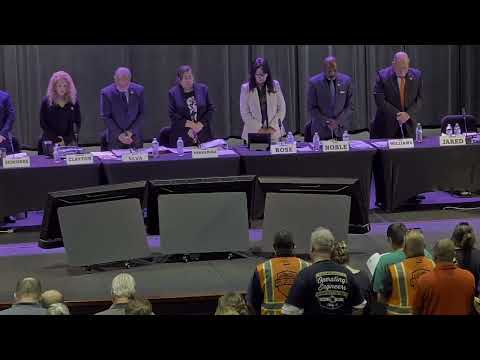
The council voted 5-0 after a lengthy public hearing and staff presentations. Council member Rose made the motion and Council member Hernandez seconded it; the roll‑call vote was recorded as Hernandez: Yes; Mayor Prom Noble: Yes; Rose: Yes; Williams: Yes; Mayor Silva: Yes.
City Manager Michelle Clayton opened the hearing by describing the scale of the proposal and its role in the general plan update, saying the project has “an estimated investment of $4 billion into this community.” BNSF’s public‑affairs director Lena Kent told the council that BIG is designed as a rail‑first “closed loop” intermodal facility that the company says will shift container movement off local roads: “The project eliminates approximately 800,000 truck trips per year, reducing congestion and emissions on our highways,” she said during the presentation.
The BIG plan includes an intermodal yard, transload warehouses, a roughly 140‑acre solar farm, multiple private roads and bridges, and an approximately 636‑acre Mojave River buffer with about 545 acres placed in conservation easement, staff and the applicant said. BNSF and the city presented commitments including a project labor agreement for union construction, zero‑emission cranes and cargo handling equipment on site, expanded renewable‑fuel use, and voluntary replacement of older yard switcher locomotives with Tier 4 engines. The company also said it will fund major off‑site utility works — new water wells, sewer trunk lines and a transmission extension — then convey those improvements to the utilities that will operate them.
Supporters, including labor groups, the Barstow Chamber of Commerce and some local business speakers, emphasized jobs and training. BNSF and local unions said the project will support construction and long‑term careers; BNSF and staff cited training partnerships with Barstow Community College. The Mojave Desert Air Quality Management District, represented by its executive, said the district “concurs with the analysis and findings for the general plan update and the BIG project as presented in these documents” and highlighted cooperative mitigation agreements.
But many residents and community groups urged the council to require stronger, enforceable mitigations. Speakers who said they live nearest planned facilities in Silven/Silverlakes, Helendale and other nearby unincorporated communities asked for sound walls, turn lanes, concrete grade separations at crossings such as Vista Road, and firm commitments to fully electric locomotion. “The EIR does not say those impacts disappear. It says they are significant and unavoidable,” said Dina Martell, a resident who said opposing impacts would begin “on day one.” Other public commenters alleged the EIR under‑counted local impacts and urged recirculation or stronger conditions.
Staff and consultants responded at length to the public input. Placeworks (EIR project manager Mark Teague) and Kimley‑Horn (traffic lead Jennifer Harry) explained the distinction between a program‑level general plan EIR (which must consider a range of unknown future projects and therefore may show some program‑level significant impacts) and the project‑level EIR for BIG (which includes detailed, site‑specific mitigation measures). Staff said tribal consultation was conducted under state law (AB 52), that two tribes responded, and that monitoring and enforcement will use consultant specialists paid from developer deposit accounts where the city lacks in‑house technical capacity. Staff and BNSF also described a temporary construction bypass and other traffic measures to limit disruption during the planned Main Street bridge reconstruction.
Financial and fiscal details presented to the council included an estimate that property‑tax revenue at full buildout could generate about $9.9 million (city share plus other affected districts), with roughly $49 million in development impact fees for infrastructure described in staff materials. Staff said the developer will install and convey major infrastructure (water lines, sewer trunk lines, transmission improvements) and that many developer contributions are staged and tied to permit and construction milestones.
What the council actually voted on was a bundle of required local approvals: certification of the Final EIR (Resolution No. 5256‑2026); adoption of the general plan update (Resolution No. 5257‑2026); introduction and waiver of second reading for zoning and specific‑plan ordinances (Ordinance Nos. 1035‑2026, 1043‑2026, 1044‑2026, 1045‑2026, 1046‑2026 as listed by staff); adoption of related resolutions approving the tentative map, authorizing road‑maintenance agreements and LAFCO annexation applications, and authorizing city staff to accept easement assignments and proceed with the development agreement and monitoring program. The full list of actions was read into the record and is in the council packet.
Council members pressed staff on implementation details — how required monitoring would be performed, how mitigation funds and consultant monitoring costs will be handled, emergency‑access impacts for remote neighborhoods, and the timing and structure of tax receipts and fees. Staff said the development agreement requires the applicant to pay consultant monitoring costs from a deposit account and to construct utilities (water, sewer, transmission) that the city or utility will ultimately maintain once conveyed. City staff acknowledged the need for an outreach program and pledged periodic town‑hall updates if the project proceeds.
Next steps: the council’s vote advances ordinance introductions, LAFCO applications for annexation and other procedural steps listed in the packet; some items (such as ordinance adoption) require follow‑up City Council action and LAFCO review. The development agreement and many construction milestones will trigger staged permit fees and payments, staff said.
Votes at a glance
- Certify Final EIR (Resolution No. 5256‑2026): Approved, 5‑0. - Adopt General Plan update (Resolution No. 5257‑2026): Approved, 5‑0. - Introduce and waive further reading for multiple ordinances to implement BIG and zoning map changes (Ordinance Nos. 1035‑2026; 1043‑2026; 1044‑2026; 1045‑2026; 1046‑2026): Introduced as part of bundled motion, 5‑0. (Final adoption to follow required procedures.) - Adopt resolutions to approve tentative tract map, development agreements, road maintenance agreement, and authorize LAFCO annexation applications (Res. Nos. 5258‑2026, 5259‑2026, 5260‑2026, 5274‑2026, 5276‑2026, 5277‑2026, etc.): Approved as read, bundled, 5‑0.
Who said what (selected quotes)
- City Manager Michelle Clayton: “This is a significant undertaking with the potential to have far‑reaching and positive impacts.” (presentation summary) - Lena Kent, BNSF: “The project eliminates approximately 800,000 truck trips per year, reducing congestion and emissions on our highways.” - Brad Pores, Mojave Desert Air Quality Management District: “The district concurs with the analysis and findings for the general plan update and the BIG project as presented in these documents.” - Dina Martell, resident: “The EIR does not say those impacts disappear. It says they are significant and unavoidable.”
What to watch next
- LAFCO annexation proceedings (6–9 months estimated by staff), development‑agreement finalization and ordinance adoptions, and the mitigation monitoring and reporting program implementation. Community members asked the council to pursue separate traffic grade separations (Vista Road) and neighborhood‑specific mitigations (sound walls, turn lanes); the council and staff said they will continue outreach and coordinate with the county and other regional agencies.
The council adjourned at 9:50 p.m.