Get Full Government Meeting Transcripts, Videos, & Alerts Forever!
Get email alerts on the Data Center Overlay topic
No spam. Unsubscribe anytime.
Council delays vote on technology‑overlay zoning after hours of expert testimony and public opposition
Summary
After a multi‑week community process presented an overlay intended to set baseline standards for hyperscale data center campuses, the council heard technical recommendations and lengthy public comment about noise, water, transmission and enforcement, then voted to continue the first reading for one week and request utility briefings.
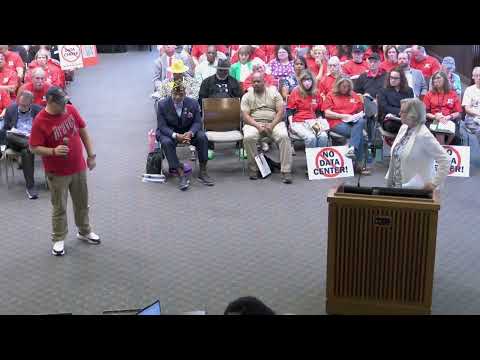
Columbus councilors continued a contentious public hearing and first reading on a proposed Unified Development Ordinance (UDO) technology overlay district on June 2 after more than four hours of presentations and public comment.
The substitute overlay—developed by an informal Chamber of Commerce committee of local engineers, utility representatives, conservation and industry experts—was presented by Jansen Tidmore, the Chamber’s CEO, as a "baseline" of elevated standards intended for hyperscale, campus‑style data centers rather than all data‑center uses. The committee recommended limiting overlays to large contiguous parcels (committee language cited 75 acres as a campus threshold), requiring utility capacity letters, acoustical modeling at the site‑plan stage, closed‑loop cooling (no evaporative cooling), enhanced setbacks and enforceable developer agreements including possible reclamation and bonding.
"This overlay ... is a baseline. It is not a yes or a no to a project," Tidmore said, adding that the overlay would be the first of several steps that would also involve Georgia Power, Columbus Waterworks and state regulatory reviews.
Technical committee members and outside consultants elaborated on enforcement and technical options: acoustical engineers urged pre‑construction noise modeling and DBC (weighted low‑frequency) metrics as well as property‑line sound limits; environmental experts recommended bonds or reclamation agreements and stronger public‑notice rules; power and water experts discussed letters from utilities confirming long‑term capacity and cost responsibilities.
Opponents in a packed council chamber urged the council to pause the process, citing long transmission build‑outs, concern over water withdrawals from drought‑prone river basins, low perceived local job creation for hyperscale campuses, possible impacts on property values and insufficient independent review. Many residents from northeast Muscogee and neighboring counties asked for a moratorium and called for independent third‑party studies and larger setbacks than those proposed.
Council members debated the substitute and the public comments and ultimately voted to continue the item for one week so that Georgia Power, Columbus Waterworks and other utilities could brief council and the public and so the council could receive additional expert input. Council did not approve any rezoning or a specific project at the June 2 meeting.
The continuation preserves time for further technical briefings, additional public engagement and staff drafting of any amendments before a final vote on whether to adopt the overlay into the UDO.