Get Full Government Meeting Transcripts, Videos, & Alerts Forever!
Get email alerts on the Education Title Ix Athletics topic
No spam. Unsubscribe anytime.
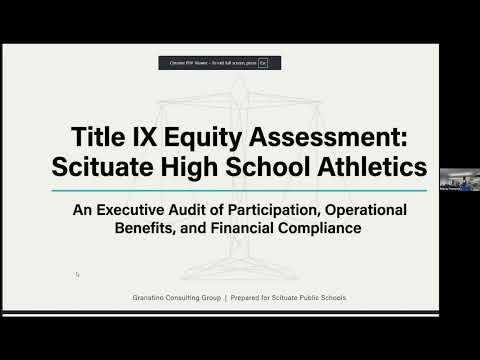
Consultant: Scituate athletics meet participation parity but needs budget, booster and scheduling fixes
Summary
A consultantled Title IX assessment found Scituate High School meets participation parity but identified gaps in budgeting, booster-account transparency, scheduling and certain equivalent benefits; the report recommends a phased corrective plan and routing booster funds through school activity accounts.
A consultant who reviewed Scituate Public Schools' athletic programs told the School Committee on June 1 that the district satisfies the Title IX participation test but should move quickly on budget and booster-accounting reforms to ensure equitable treatment.
Jeff Cranino, the external assessor, summarized a 46-page report he will post publicly and said the district's five-year participation data show near parity: "Over the last five years we've had about 49.9% of the school enrollment female and 49.3% of the athletes female," he said, placing the district within the 5% safe-harbor range for participation.
That numerical finding, Cranino said, does not end the review. His audit examined participation, equivalent benefits (facilities, coaching, scheduling, publicity and medical services), financial records and administrative compliance. He told the committee he conducted stakeholder interviews with parents, students, coaches, boosters and administrators, reviewed five years of business-office records and observed games and facilities.
Why it matters: Cranino warned that booster fundraising and current budget practices can undermine equitable access even when participation numbers look balanced. "Booster organizations bring in on average about $165,000 a year above and beyond the operating budget," he told the committee, adding that much of that money has not flowed through school accounting in a way that allows administrators to correct disparities.
Key findings and recommendations
- Participation: The district met the substantial-proportionality test; participation numbers and program growth were roughly commensurate for boys and girls over the five-year review.
- Equivalent benefits: Facilities scored strongly overall, but stakeholders raised concerns about prime-time scheduling (night games and high-visibility slots), marketing and social-media promotion favoring some male programs, uneven access to medical/trainer coverage at certain home events, and specific facility issues (most notably a temporary softball fence that creates a sense of unequal investment).
- Financial transparency: Cranino described the athletic budget as a rollover model that does not start from a needs-based, program-level budget each year. That practice, combined with boosters keeping funds outside the district's activity-account processes, makes it difficult to determine how expenditures align with equity goals.
- Boosters and outside funding: The report recommends requiring booster and outside fundraising to be accepted and deposited into activity accounts managed by the business office, with standardized approval and reporting, so the district can reconcile external contributions with the operating budget and, if necessary, direct funds to offset disparities.
- Operations and staffing: Cranino urged standardized hiring practices for coaches, clearer processes for filling vacancies, improved coach- and volunteer-recruitment on the girls' side (where he observed greater turnover), and better scheduling so that athletes and trainers do not face avoidable conflicts.
Actions requested and next steps
Committee members asked the administration to produce a corrective-action timeline and an initial draft plan that prioritizes immediate fixes (scheduling and communications), mid-term changes (budget modernization and activity-account transparency) and longer-term items (booster governance, facilities work and hiring-process standardization). Cranino offered continued availability to consult as the district develops those plans.
Representative quotes
"This was strictly about looking at adherence to the department's adherence to Title IX expectations," Cranino said, underscoring that the review was compliance-focused rather than a critique of individual staff.
"Booster funds sway things," he added, arguing that booster dollars should be tracked through the business office so the district can make up disparities when one program receives substantially more outside support.
Full report and provenance
The consultant said the complete Title IX assessment (46 pages) will be posted online the morning after the meeting; the committee first heard the report in public on June 1. The committee asked administration for a draft corrective-action plan and a timeline to review before public release.
Ending: The School Committee directed central office to work with the consultant and return a prioritized corrective plan; the committee signaled urgency for early-fall checkpoint and more frequent check-ins as the district implements changes.