Get Full Government Meeting Transcripts, Videos, & Alerts Forever!
Get email alerts on the Traffic Calming topic
No spam. Unsubscribe anytime.
Fairfax County presents Doyle Road traffic‑calming plan; neighbors worry about meeting ballot threshold
Summary
Fairfax County DOT proposed three speed tables and one speed hump for Doyle Road after a traffic study found 85th‑percentile speeds of 41 mph northbound and 39 mph southbound. The plan must win 15 of 29 ballots; residents said collecting enough returned ballots could be difficult.
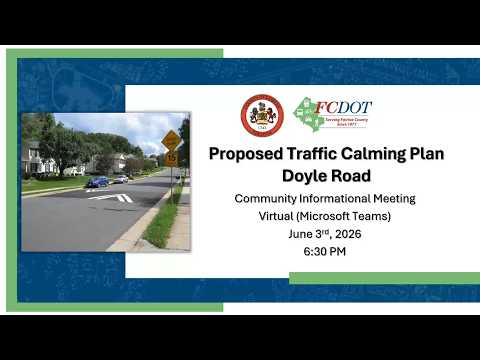
Steve Kudson, who said he works for Fairfax County Department of Transportation, opened a virtual community meeting to present a traffic‑calming plan for Doyle Road and to answer residents' questions.
FC DOT presenter Ryan O'Carol outlined the county's traffic‑calming program and the Doyle Road proposal, saying the roadway met both the program's volume and speed thresholds. "We're going to discuss the traffic calming program for Doyle Road," O'Carol said, then described vertical devices (speed humps) and horizontal devices (raised median islands) used to reduce vehicle speeds.
Why it matters: FC DOT said lower speeds improve drivers' visual acuity and shorten stopping distance; the department also noted the county has completed more than 279 traffic‑calming projects and installed over 665 devices across districts. For Doyle Road, FC DOT reported a recorded 24‑hour volume of 510 vehicles and 85th‑percentile speeds of 41 mph northbound and 39 mph southbound, which meet the program's stated thresholds.
What the plan would install: Based on a field visit, FC DOT proposed three speed tables and one speed hump along Doyle Road. Plans released at the meeting included schematics: a speed hump 12 feet long and 3 inches high at center, and speed tables 22 feet long and 3 inches high at center, each with chevrons and advisory signs recommending a 15 mph speed near the device.
Balloting and thresholds: Organizers said the ballot area covers 29 occupied properties. Each occupied property receives one ballot, returned directly to the Springfield District Supervisor's Office by mail, hand delivery, or email. The minimum ballot period is three weeks, but staff said task forces may extend the period. Because the requirement is a majority of issued ballots, the plan needs at least 15 yes votes to pass. FC DOT emphasized that ballots collected by the task force will not be counted and that a verified ballot package and a completed cover letter are required before distribution.
Community concerns and staff replies: Several residents raised concerns about turnout and the small size of the ballot area. "I just am not confident that everybody will submit their stuff directly within the three weeks," one participant, Trish, said, asking whether the project would fail if not all ballots were returned. FC DOT replied, "It can be left open longer...the minimum is three weeks and we can leave it open, you know, for four weeks or five weeks if that would make you feel more comfortable."
Jed Williams, who said he has been working with others to gather adjacent‑property signoffs, told staff the effort had taken months and that some neighbors are infrequently present or unresponsive. "It's just tricky with a small population...some people on the task force are out of the country right now," Williams said. Staff reiterated options: delay balloting, do canvassing beforehand, and schedule an optional ballot meeting with FC DOT to review processes and finalize the ballot package.
Next steps: FC DOT asked that the task force email Payton in the Springfield District Supervisor's Office to request a ballot meeting and offered to provide a ballot template, address list and editing support. If the ballot passes, FC DOT will seek endorsement from the Fairfax County Board of Supervisors and then coordinate with the Department of Public Works and Environmental Services to schedule installation. The department said the recording and slides from the meeting will be shared with the task force and other community members.
The meeting closed after organizers invited any final questions and confirmed contact information for follow‑up.