Get Full Government Meeting Transcripts, Videos, & Alerts Forever!
Get email alerts on the Data Centers topic
No spam. Unsubscribe anytime.
Committee advances moratorium on large AI-style data centers after public testimony; amendments add limits and OSC role
Summary
The Land Use and Sustainability Committee advanced Council Bill 121214, a temporary moratorium targeting new hyperscale data centers, adopting two amendments to allow limited expansions for existing critical facilities and to place the Office of Sustainability and Environment (OSC) in the work plan; the committee voted 5–0 to recommend passage.
Seattle’s Land Use and Sustainability Committee on June 3 recommended passage of Council Bill 121214, a temporary moratorium meant to pause the siting and expansion of new hyperscale data centers while the city develops permanent rules and a community benefits framework.
The committee adopted two amendments before voting to advance the bill. Amendment One clarifies that existing data center facilities may expand up to the threshold identified in the new definition (measured in megavolt-amperes, MVA) without counting the facility’s current capacity toward that threshold; the committee adopted it by roll call vote, 5–0. Amendment Two adds the Office of Sustainability and Environment into the moratorium’s work plan and assigns OSC a lead role in developing a community benefit framework; it passed 5–0.
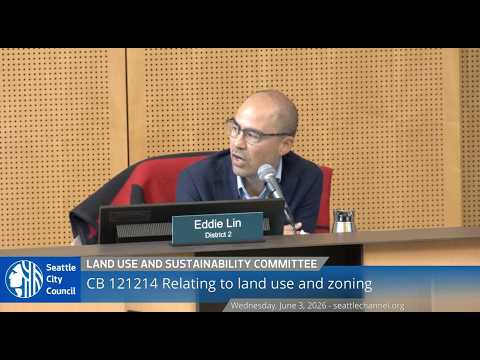
Chair Eddie Lin moved the committee recommendation to pass the bill as amended and the roll call recorded five votes in favor and zero opposed. In committee discussion and in presentations, staff and Seattle City Light explained the measure will use megavolt-amperes (MVA) in part because MVA reflects equipment- and service-level sizing for large-load customers.
Public comment before the vote ran for roughly an hour and featured more than two dozen callers and in-person speakers. Residents, tech workers and environmental groups described concerns including: high water and energy consumption of hyperscale facilities; strain on the power grid and local utilities; noise and heat-island effects; and environmental-justice questions about siting in overburdened neighborhoods. “These data centers consume far more water and energy than the smaller centers,” Rebecca Young, a District 3 resident, told the committee, and Audrey, an electrical engineer, said a moratorium “will give us time to ensure we have the right safeguards.” Several commenters urged mandatory, not voluntary, community benefit agreements.
City staff and OSC representatives told the committee the moratorium is intended as a temporary pause to allow interdepartmental coordination—including Seattle City Light, Seattle Public Utilities and SDCI—plus engagement with tribes and impacted communities. OSC staff highlighted issues the work plan should address: noise, heat output and heat-island impacts, electricity and water capacity, e-waste handling, and urban forestry impacts.
The committee’s action advances the moratorium recommendation to the full Council for final consideration. Next steps cited by staff include a work plan and public engagement to produce permanent regulations, thresholds for covered projects and a community benefits framework.
Actions recorded in committee include two adopted amendments and the committee recommendation to pass CB 121214 as amended; the committee reported the bill will proceed to the Council as amended.