Get Full Government Meeting Transcripts, Videos, & Alerts Forever!
Get email alerts on the Poet Laureate Governance topic
No spam. Unsubscribe anytime.
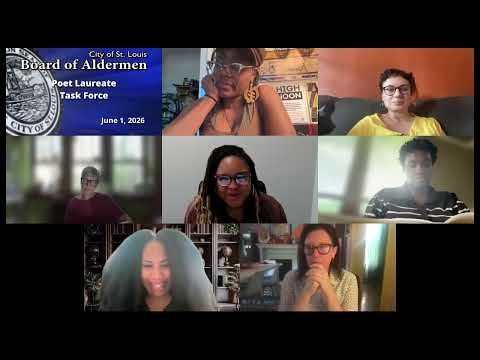
St. Louis Poet Laureate Task Force debates outreach plans and clarifies meeting, residency rules
Summary
At its June 1 meeting the City of St. Louis Poet Laureate Task Force discussed stepped‑up outreach and marketing for the poet laureate, options for drafting ordinance revisions (including residency language), and whether offsite gatherings must be noticed under Sunshine Law.
The City of St. Louis Poet Laureate Task Force met June 1, 2026, to strategize ways to boost the visibility of the city’s poet laureate and to plan work sessions to revise the poet laureate ordinance. Members focused on publicity and partnership ideas and asked city staff to clarify whether proposed offsite gatherings would require public notice under the Sunshine Law.
Task force members proposed several outreach tactics intended to broaden the laureate’s audience and support. Ideas included using the mayor’s or city social media accounts to amplify poetry programming, partnering with community mural projects to embed poems in public art, attending farmers markets and neighborhood events, and coordinating short weekly updates from a single point person so the laureate would not need to publicize every engagement personally.
A member of the task force said the most practical forms of support would be marketing and fundraising: “I’m terrible at asking for money and I’m terrible at telling people about things if you’re not in front of my face,” the poet laureate told the group, explaining why coordinated promotion and a communications point person would help.
The body also discussed process questions tied to a future ordinance revision. Members asked whether the ordinance should require the poet laureate or task force members to be city residents, or whether a looser ‘‘connection to the city’’ standard (work, schooling or regular activity in the city) would be acceptable. Task force members described the current residency language as ambiguous and asked staff to seek clarification.
A staff member flagged legal‑notice considerations under Missouri open‑meeting rules and the task force’s chosen transparency practices, noting that offsite meet‑and‑greet events that involve official business could require public notice. The chair said she would draft a proposed agenda for the working session and send it to Christine (city staff) to determine whether the event should be formally noticed or reviewed by the city counselor’s office. Christine agreed to take the proposed outline to her team for advice.
Procedural business at the start and end of the meeting was routine: the task force approved minutes for prior meetings by voice vote and later moved, seconded and approved adjournment at 4:58 p.m.
Next steps: the chair will circulate a proposed agenda for a working session; city staff will advise whether that meeting must be publicly noticed. The task force signaled support for creating a standing point person to help the poet laureate with promotion and for clarifying residency language in the ordinance before launching the next application cycle.