Get Full Government Meeting Transcripts, Videos, & Alerts Forever!
Get email alerts on the Transitional Housing Vincennes topic
No spam. Unsubscribe anytime.
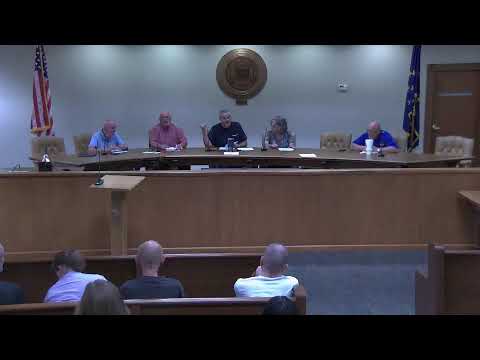
Vincennes zoning board approves parking variance for proposed Golden Touch transitional home amid neighborhood objections
Summary
The Vincennes Board of Zoning Appeals on June 3 approved a parking variance for Mahogany Barnhart’s proposal to operate Golden Touch Housing and Services at 2021 Washington Avenue, after neighbors raised concerns about parking, capacity and safety; the board said its authority was limited to parking, and other operational matters fall to county planning or other agencies.
Mahogany Barnhart told the Vincennes Board of Zoning Appeals on June 3 that she plans to open Golden Touch Housing and Services, a transitional home in a remodeled three-bedroom house at 2021 Washington Avenue aimed at providing case management, meals and a path to work. Barnhart said she obtained organizational paperwork and bylaws and that residents would follow house rules and participate in services: "This fully furnished three-bedroom home is designed to provide stability, dignity, and support."
Neighbors who spoke at the hearing urged caution. Christopher Williams of 114 Perry Street said the neighborhood already has heavy foot traffic and sanitation problems and warned the project could increase those issues: "We have three registered sex offenders on this one block alone," he said, adding that an influx of people could bring "more of the same" he described as a nuisance. Marshall Clifton (1128 Perry Street) told the board he feared the presence of a shelter would lower nearby property values, and several residents questioned whether a three-bedroom, one-bathroom house could safely host the number listed on the application.
Board members repeatedly emphasized the narrow scope of the hearing. A board member told the audience that "the only thing we can legally rule on is parking," and the record shows multiple speakers and neighbors raising concerns about bathrooms, screening, staffing and funding that fall outside the board’s zoning review. Russ Whitman and others also raised questions about legal notice; the board explained that state law requires notice to adjoining properties and that the city runs published notices in the paper.
Barnhart answered questions about operations: she said an intake form and background checks would be required for residents, that the facility would aim to house five to seven people initially from among those she already assists, and that two staff would be on-site at all times. She said residents would contribute toward utilities or a bed fee as they gain employment and that she had arranged local supports and virtual therapy resources. Barnhart told the board she already feeds "more than 10 people" through her restaurant and has worked with local outreach organizations during intake and referral.
Troy Pickle, director of First City Sunrise, a Vincennes homeless outreach, spoke in support of Barnhart’s plan and described the proposal as a transitional home rather than an emergency shelter: "We are not opposed or against her business. And she's been a great support for meals to our shelter," he said, and offered to share data and vetting practices with the board.
After public comment and board discussion focused on the parking configuration (applicant described two private parking spaces inside a fenced area, a driveway that can fit two to three cars and two front curb spaces), the board moved and, by the chair’s account, voted unanimously among members present to grant the requested parking variance. The board recorded that its approval applied only to the parking variance; other approvals (land use, occupancy and operational regulations) remain subject to county planning and applicable state rules, including references in the record to Indiana restrictions on sleeping in public places and county planning oversight.
The board also approved routine minutes and moved to close the hearing. Neighbors were encouraged to direct questions about county zoning or conditional-use determinations to Knox County area planning, which a board member identified as the agency that granted the applicant’s county-level clearance. The board did not impose operational conditions (for example, mandatory neighborhood meetings) as part of its variance approval; it noted neighbors may request voluntary coordination with Barnhart outside the formal ruling.