Get Full Government Meeting Transcripts, Videos, & Alerts Forever!
Get email alerts on the Public Health topic
No spam. Unsubscribe anytime.
Rosemount council approves free filter‑pitcher program for households with infants after manganese monitoring
Summary
The Rosemount City Council approved a voluntary program to provide free pitcher filters (with a year of replacement filters) to households with infants 0–12 months after city monitoring found manganese levels near or above EPA‑recommended limits for infants; council set a targeted July 1 distribution start and estimated annual cost of about $20,000.
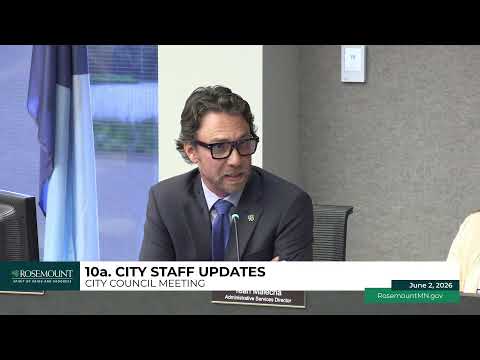
The Rosemount City Council on June 2 approved a voluntary infant water filter pitcher program to give eligible households with infants (0–12 months) a filter pitcher and one year of replacement filters to reduce manganese concentrations in tap water used to prepare infant formula.
City staffer Mr. Edgar told the council that municipal monitoring over an 18‑month period showed manganese levels at some wells in the 100–150 micrograms per liter range, and that distribution‑system samples often approached or exceeded the Environmental Protection Agency guidance for infants (which the presenter cited as 100 micrograms per liter for children under one year; he stated adults have a recommended level of about 300 micrograms per liter). Because formula combined with tap water can raise an infant’s total exposure, the city proposed an optional mitigation program targeted at households with infants.
Under the city’s proposal, eligible residents who live in Rosemount and certify an infant’s age (via a birth certificate or similar proof) and residency (utility bill or ID) will be able to pick up a filter pitcher at Public Works. Staff said verification would be recorded but not retained as sensitive copies. Based on demographic estimates and U.S. Census birth‑rate inputs, staff estimated about 300–350 infants in the city in any given year. The city estimated an annual program cost (pitcher plus six replacement filters per household) at about $20,000.
Mr. Edgar said the program is voluntary and that the city has worked with the Minnesota Department of Health on the matter. On outreach, staff plan a multi‑channel campaign including a city website news flash, social media posts, printed pamphlets at city facilities, and a local newspaper blurb. The city also plans a water‑quality public outreach event on June 18 with state and county agency experts.
Councilmember Esler moved to implement the program; Councilmember Climple seconded. Roll call showed Esler, Climple, Weisensel and Tyson voting yes and the motion passed 4–0. Staff said a bulk order of pitcher kits is expected in June and that distribution would begin around July 1.
“This is an optional solution for folks if they so choose,” Mr. Edgar said, describing monitoring results and the proposed verification and distribution process.
The council’s action funds the pilot‑style distribution and directs staff to begin the procurement and outreach needed to make pitchers available to eligible households.