Get Full Government Meeting Transcripts, Videos, & Alerts Forever!
Get email alerts on the Canine Leishmaniasis Importation topic
No spam. Unsubscribe anytime.
CDC presenters outline tools to assess risk of canine Leishmania importation and country-level risk map
Summary
CDC presenters described an Operational Risk Assessment Tool (ORAT) to evaluate the probability that an imported dog infected with Leishmania infantum could lead to local transmission, and a literature-based country-level risk map to guide testing and public-health responses for imported dogs.
Keisha Bohannon of the CDC One Health Office opened the May Zoonoses and One Health Updates Call and introduced presentations on tools to assess the risk that imported dogs could introduce or help establish Leishmania infantum in the United States. "This webinar is designed for veterinarians, physicians, epidemiologists, and other public and animal health professionals," Bohannon said at the start of the session.
Dr. Christine Petersen provided technical background on Leishmania infantum, describing dogs as the primary reservoir and sand flies as the biological vector. "Dogs are the primary reservoir species of Leishmania infantum," Petersen said while outlining the parasite life cycle and global distribution. She noted that visceral leishmaniasis has been reported in roughly 88–89 countries and cited an estimated 20,000 human deaths annually worldwide. Petersen also reviewed a phylogenetic analysis of U.S. canine samples, saying the U.S. strains cluster most closely with samples from southern Europe, suggesting a likely European origin for the strains detected in U.S. hunting hounds.
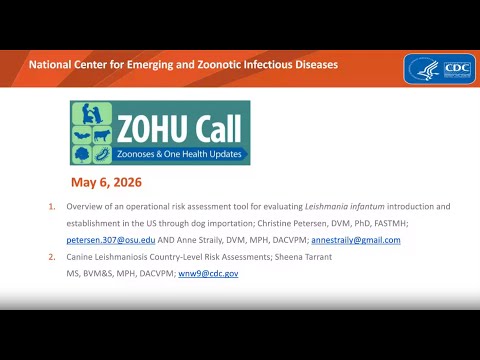
Dr. Anne Straily described the Operational Risk Assessment Tool (ORAT), a qualitative framework intended to help animal-health and public-health officials assess and manage the risk from an imported dog infected with L. infantum. "This Operational Risk Assessment Tool, which I'll refer to as the ORAT for short, is a qualitative risk assessment tool," Straily said. The ORAT evaluates three stages—entry (probability the dog is infected on import), exposure (probability infected dogs can transmit to permissive local vectors), and consequence (expected impacts on animal and human health)—and combines those inputs into an overall risk estimate using a matrix with qualitative categories (very low, low, moderate, high).
Straily explained key assumptions and uncertainties built into the ORAT. Assumptions include treating imported dogs as roughly representative of the U.S. dog population for modeling purposes, considering certain U.S. sand flies to be permissive vectors, and assuming topical sand-fly preventives reduce feeding and infectiousness. She emphasized varying uncertainty across steps: the entry and consequence assessments carried "low" uncertainty in the tool's framing, while the exposure assessment—particularly whether domestic sand flies can transmit L. infantum between animals—was labeled with "high" uncertainty.
To illustrate the tool, Straily walked through a case study of a fictitious dog named Daisy, imported from Spain and intended for breeding. Daisy had prior diagnostic evidence of infection and had not received sand-fly preventive treatment; using the ORAT, presenters rated the probability of importation as high, the probability of vector-borne transmission as moderate given Georgia as the destination, and the combined overall risk as high. Based on such an assessment, the presenters identified mitigation options including consistent use of sand-fly preventives, excluding infected dogs from breeding and blood-donation programs, counseling owners (particularly immunocompromised owners), and ensuring veterinary teams use standard precautions to minimize iatrogenic exposures.
Dr. Sheena Tarrant presented a companion resource: a country-level, literature-based risk assessment and map for canine leishmaniasis designed to help clinicians and regulatory officers decide when to test imported dogs. "Every year, an estimated 1 million dogs are imported to the United States," Tarrant said in introducing the need for a centralized resource. Her team compiled literature from 2019–2023, applied a standardized rubric to score countries on evidence of canine disease and permissive vectors, and performed inter-reviewer quality control and map-level checks to identify anomalies. The resulting map and an alphabetized table of country risk assessments are available via PubMed Central and linked in the webinar materials.
During the Q&A, presenters addressed practical concerns raised by attendees. On needlestick exposures after drawing blood from an infected dog, Petersen recommended case-by-case clinical follow-up and offered CDC Parasitic Diseases Branch contact information (parasites@cdc.gov) for clinicians with questions. Regarding reportability, presenters said making a condition reportable is most useful when public-health authorities have clear, actionable responses; they cautioned that reportability alone can add workload without improving outcomes if jurisdictions lack capacity to act. When asked why known-infected dogs are sometimes allowed entry, presenters reiterated that regulatory changes are based on formal risk reassessments weighing introduction probability and potential public- and animal-health impacts.
The session closed with links to resources (including Screwworm.gov and the webinar handouts), a reminder that a captioned video will be posted on the May call page, and information about free continuing-education availability. Presenters noted the ORAT was published in Emerging Infectious Diseases (December 2024) and the country-level map and supplemental tables are available on PubMed Central; attendees were encouraged to review the full articles for methodological details and appendices that explain scoring decisions.
Next steps identified by presenters included using the ORAT to guide case-level public-health assessments, consulting the country-level map when evaluating travel and importation histories, and following state or local rules on disposition of dogs with leishmaniasis. Presenters also encouraged clinicians to consider leishmaniasis testing when clinical signs are suggestive, even for dogs from countries classified as low risk by the literature-based map.