Get Full Government Meeting Transcripts, Videos, & Alerts Forever!
Get email alerts on the Fund Size And Access topic
No spam. Unsubscribe anytime.
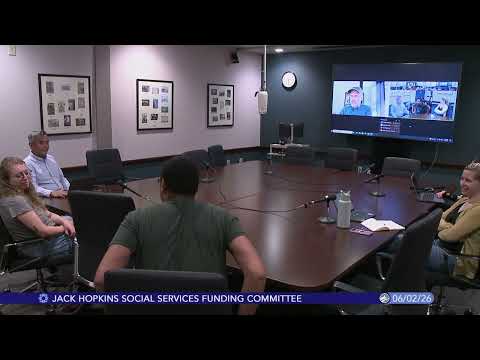
Panel debates growing Jack Hopkins fund, but E-Verify rules blocked at least one applicant
Summary
Committee members discussed proposals to increase the Jack Hopkins fund to support a larger, collective homelessness project and debated allocation by topic; they also heard that Silver Linings could not participate because of E-Verify requirements and discussed accepting IRS paperwork instead.
Members of the Jack Hopkins social service grant committee discussed whether the program should scale up beyond the roughly $500,000 annual fund and highlighted how administrative barriers kept some applicants from completing submissions.
One participant suggested increasing the fund "to a million dollars" and noted that a $500,000 allocation could, for example, fund a year of housing for a cohort of unsheltered residents as part of a coordinated effort. Committee members weighed that approach against continuing to distribute many smaller awards across multiple providers, acknowledging trade-offs between scale and reach.
Several members proposed reserving a portion of the total fund for priority categories (examples discussed included child welfare and food insecurity) while leaving flexibility for large demonstrated needs. Participants emphasized the difficulty of pre-allocating category amounts and flagged risks of arbitrarily reducing overall flexibility.
On access, a committee member said the executive director of Silver Linings, Rachel, "dropped out because she couldn't get E-Verify," and suggested the committee consider accepting IRS paperwork or other documentation for organizations that lack payroll or staff and therefore cannot complete E-Verify. That change was proposed to avoid excluding volunteer-run or fiscally sponsored groups that otherwise meet grant criteria.
Why it matters: discussions about fund scale and allocation affect whether awards prioritize many small providers or a few larger, potentially transformative interventions. Administrative barriers such as rigid E-Verify requirements can effectively shut out small or volunteer-led organizations from competing for funds.
Next steps: committee members signaled interest in exploring fund-size scenarios and a staff recommendation on alternative proof-of-organization documentation to replace E-Verify where inappropriate. No final decisions or votes were recorded during the debrief.